Research institutions generate extraordinary volumes of knowledge. Grant proposals, compliance documentation, internal policy manuals, research papers, audit records, funding guidelines, experimental data summaries, and review notes accumulate year after year.
Yet most of this institutional intelligence remains locked inside static documents and fragmented systems.
Researchers search manually. Administrative leads cross-reference policy requirements line by line. Principal Investigators rely on memory, email threads, and informal networks to retrieve historical context. Compliance teams review documents reactively rather than proactively.
Generative AI has introduced powerful new capabilities. But simply deploying a chatbot over documents does not solve the deeper structural challenge.
Research institutions do not need another search interface. They need coordinated intelligence.
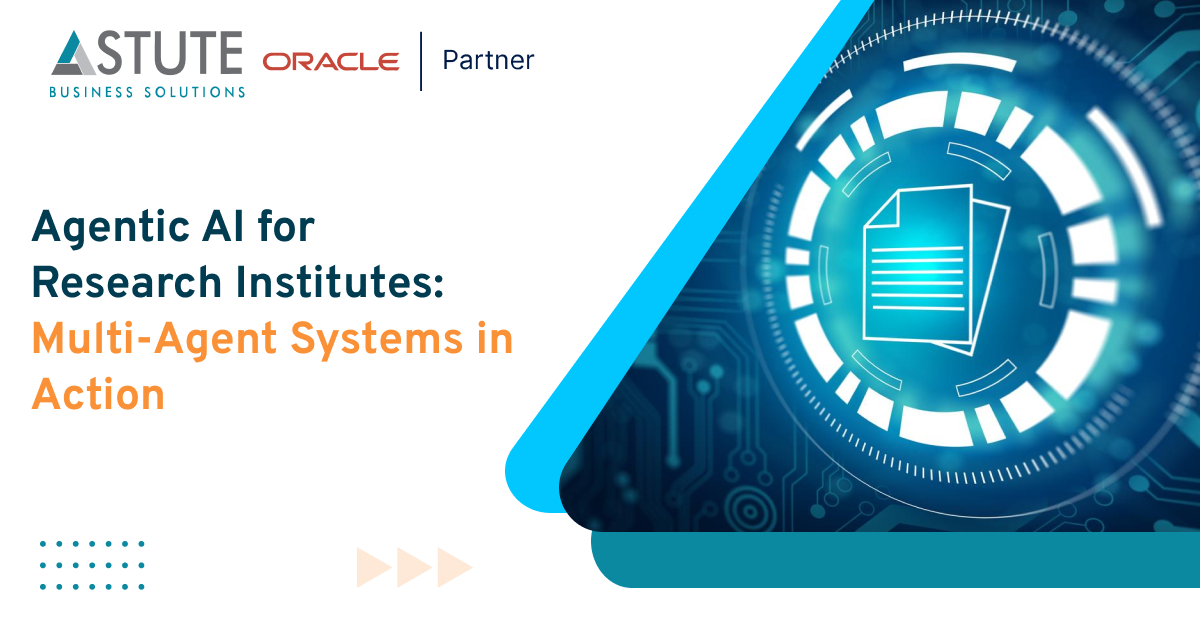
This is where Agentic AI and multi-agent systems redefine what is possible.
From Document Search to Coordinated Intelligence
Traditional AI deployments in research environments focus on retrieval. A user asks a question, and the system returns a summary of relevant documents.
That is helpful. But it is still reactive.
Agentic AI introduces a more advanced model. Instead of a single large model responding to prompts, a multi-agent system assigns specialized responsibilities to different AI agents. Each agent performs a distinct role, collaborates with others, and operates within secure institutional boundaries.
The result is not just faster document search. It is structured reasoning, cross-document comparison, compliance validation, drafting assistance, and policy alignment happening in a coordinated sequence.
In research institutes, this approach has significant implications:
- Grant requirements can be automatically cross-referenced against internal policy.
- Proposal drafts can be enriched using historical institutional knowledge.
- Compliance risks can be flagged before submission.
- Research insights can be synthesized across multi-year studies.
Agentic AI transforms static documentation into an active knowledge ecosystem.
Why Research Institutes Are Uniquely Positioned for Agentic AI
Research organizations operate at a level of complexity few industries experience:
- Multiple funding bodies with evolving guidelines
- Strict compliance requirements
- Multi-year research programs
- Distributed collaboration across departments
- High audit scrutiny
- Sensitive intellectual property
The cost of inconsistency is high. A missed compliance clause or outdated reference can delay funding, increase audit exposure, or compromise proposal quality.
Yet administrative leaders often spend hours manually cross-checking documents.
Agentic AI addresses these structural inefficiencies by embedding intelligence directly into the research workflow.
Instead of replacing systems, it augments them.
Instead of introducing disruption, it introduces coordination.
The Four-Agent Model in Research Environments
A practical implementation of Agentic AI in research institutes typically involves specialized agents working together. While configurations vary, a structured four-agent model often delivers the strongest results.
The Librarian Agent
This agent is responsible for semantic retrieval. It understands context rather than just keywords. When a researcher asks:
“Have we submitted a similar NIH proposal in the past five years?”
The Librarian retrieves historically relevant documents using vector-based semantic search. It identifies conceptually similar grants, even if the terminology differs.
The result is contextual retrieval grounded in institutional knowledge.
The Analyst Agent
The Analyst performs reasoning across documents.
For example:
- Compare new grant requirements against institutional policy.
- Identify discrepancies between internal compliance procedures and updated funding rules.
- Generate trend summaries across multi-year research outputs.
This agent reduces hours of manual comparison work to minutes of structured analysis.
The Writer Agent
Proposal drafting remains one of the most time-consuming research activities.
The Writer agent supports:
- Context-aware drafting using institutional history
- Compliance-aligned language generation
- Structured formatting aligned to funding body requirements
- Citation consistency checks
Rather than generating generic content, it produces drafts grounded in approved internal documentation.
The Guardian Agent
Compliance is continuous, not episodic.
The Guardian agent monitors:
- Policy drift between grant requirements and research execution
- Missing documentation
- Required audit artifacts
- Data handling alignment with institutional standards
Instead of discovering issues during audits, institutions identify them early.
This proactive compliance capability is one of the most transformative aspects of Agentic AI in research settings.
From Pilot Projects to Production-Grade AI
Many institutions have experimented with AI tools in isolated departments. A research lab tests a chatbot. A grants team experiments with document summarization. A compliance office pilots automated extraction.
The challenge is scale.
Agentic AI requires a structured architecture:
- Secure data ingestion pipelines
- Vector storage for semantic retrieval
- Workflow orchestration layers
- Role-based access controls
- Audit logging and governance mechanisms
Without this foundation, AI remains a pilot rather than a platform.
Astute approaches Agentic AI as an operational capability, not a novelty feature. The goal is to embed multi-agent coordination within institutional infrastructure, ensuring that security, compliance, and system integration are foundational, not afterthoughts.
Measurable Business Impact
When properly implemented, Agentic AI delivers tangible outcomes:
- 50–70 percent reduction in document processing effort
- Significant acceleration in proposal drafting cycles
- Up to 90 percent improvement in cross-document compliance accuracy
- Reduced audit risk through proactive monitoring
- Faster retrieval of historical institutional knowledge
- For research institutes competing for funding, time is a strategic advantage.
Shortening the proposal cycle by even a few days can influence submission quality. Reducing administrative overhead allows researchers to focus on scientific contributions rather than paperwork.
Security and Governance Considerations
Research institutions handle sensitive intellectual property, funding data, and regulatory documentation. Any AI deployment must meet enterprise-grade security standards.
A robust Agentic AI architecture includes:
- Controlled data boundaries
- Encryption at rest and in transit
- Access segmentation by role
- Structured audit trails
- Integration with existing identity management systems
- Clear model governance policies
Agentic AI is not about exposing data to open systems. It is about creating secure internal intelligence layers.
Astute’s AI deployments prioritize governance as a first principle, ensuring that innovation does not compromise institutional integrity.
Integrating with Existing Research Systems
One of the most common concerns is disruption.
Research institutions operate across ERP platforms, grants management systems, document repositories, HR and finance systems, and research databases.
Agentic AI should not require the replacement of these systems.
Instead, it sits as an intelligence layer:
- Ingesting documents from existing repositories
- Connecting via secure APIs
- Orchestrating workflows across departments
- Feeding structured insights back into operational systems
The goal is augmentation, not overhaul.
This approach allows institutions to preserve investments while gaining AI-driven coordination.
Cultural Impact: Empowering Researchers and Administrators
Beyond operational efficiency, Agentic AI influences culture.
Administrative leads spend less time cross-checking clauses and more time advising researchers strategically.
Researchers gain immediate access to institutional memory.
Principal Investigators can synthesize internal findings alongside external literature faster.
Compliance teams move from reactive auditing to proactive governance.
When intelligence becomes embedded in workflow, friction decreases.
And when friction decreases, innovation accelerates.
The Strategic Imperative
Research funding environments are increasingly competitive. Regulatory scrutiny continues to intensify. Institutions are expected to demonstrate transparency, compliance, and measurable outcomes.
In this context, static document repositories are insufficient.
Agentic AI represents a shift from passive storage to active reasoning.
From isolated search tools to coordinated intelligence systems.
From manual cross-referencing to automated validation.
Research institutions that adopt multi-agent systems early will not just operate more efficiently. They will operate more strategically.
The Role of Astute
Deploying Agentic AI requires more than technical implementation. It requires domain understanding, governance expertise, and system integration capability.
Astute brings experience in AI-driven enterprise modernization and secure architecture design, enabling research institutes to operationalize multi-agent systems within complex environments.
Rather than delivering generic AI tools, Astute focuses on structured frameworks tailored to institutional workflows.
The objective is clear:
Make research knowledge active.
Make compliance proactive.
Make intelligence operational.
Conclusion
Agentic AI is not a theoretical concept. It is an operational model that coordinates retrieval, reasoning, drafting, and compliance into a unified system.
For research institutes, this approach transforms documentation into dynamic institutional intelligence.
Multi-agent systems are not about replacing researchers. They are about amplifying them.
In a funding landscape defined by precision, compliance, and speed, coordinated AI is becoming a strategic advantage.
The question is no longer whether AI can assist research.
The question is how effectively it can be embedded, governed, and scaled.
Agentic AI provides that path.



.svg)


.svg)




.svg)

-2.svg)
-1.svg)


.svg)


.svg)
.svg)
.svg)

.svg)

.svg)
.svg)


.svg)

.svg)
.svg)
.svg)
.svg)
.svg)
.svg)
.svg)
.svg)
.svg)


.svg)
.svg)
.svg)
.svg)


.svg)
-1.svg)
.svg)
.svg)
.svg)

.svg)
.svg)

.svg)
.svg)

.svg)
.svg)
.svg)
.svg)
.svg)
.svg)
.svg)






.svg)