Enterprise finance teams are under constant pressure to operate faster, improve financial accuracy, and control operational costs. At the same time, the volume of financial transactions continues to grow. Invoice processing, expense auditing, contract reviews, and reporting cycles require finance departments to manage large amounts of operational data.
Many organizations rely on Oracle ERP platforms such as PeopleSoft, Oracle E-Business Suite, and JD Edwards to manage these financial processes. These systems remain the backbone of enterprise finance. They manage procurement, accounts payable, general ledger operations, and financial reporting across global organizations.
However, the expectations placed on finance teams today are very different from when many ERP environments were first implemented. Executives expect real-time visibility into financial operations. Finance teams must reduce manual effort while maintaining strong governance and compliance.
This is where artificial intelligence is beginning to reshape how finance operations function inside Oracle ERP environments.
AI is not replacing ERP systems. Instead, it is introducing intelligence into the financial workflows that run through them every day.
Why Finance Operations are Changing
Finance departments once focused mainly on transaction processing. Their responsibilities centered on recording financial events, managing compliance, and producing reports for leadership.
Today, the finance function plays a much broader role. CFOs and finance leaders are expected to provide operational insight that supports business strategy. They must identify cost trends, manage working capital, and support faster decision-making.
These responsibilities are difficult to manage when large portions of financial operations depend on manual processes.
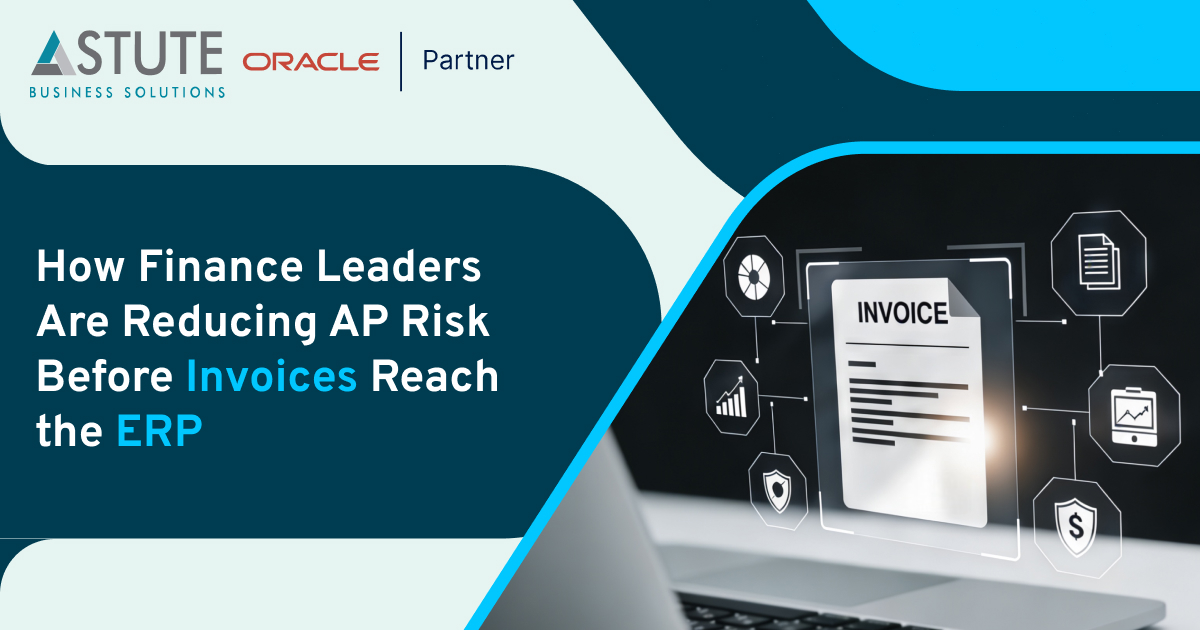
Accounts payable is a clear example. Many organizations still rely on manual invoice review, data entry, and exception handling. Finance staff spend hours interpreting invoice documents and verifying data before transactions reach the ERP system.
This type of manual work slows financial operations and increases the risk of data errors.
AI technologies are now helping organizations modernize these workflows without requiring a full ERP replacement.
The Role of AI in Oracle ERP Finance Environments
Artificial intelligence introduces automation and intelligence into the operational layer surrounding ERP systems.
Rather than replacing Oracle ERP platforms, AI solutions extend their capabilities by automating the tasks that typically happen before and after ERP transactions.
These tasks include:
- Invoice data extraction and validation
- Financial document interpretation
- Exception detection and routing
- Approval workflow optimization
- Financial data analysis and reporting
When these processes are automated, ERP systems receive cleaner data, and finance teams spend less time managing routine operational work.
The result is faster financial cycles and stronger operational control.
How AI Improves Accounts Payable Operations
Accounts payable remains one of the most resource-intensive functions within enterprise finance.
Invoices arrive from multiple channels, including email attachments, supplier portals, EDI systems, and scanned documents. Each invoice must be interpreted, verified, matched against purchase orders, and approved before it can be posted in the ERP.
Traditional OCR-based tools attempted to automate parts of this process. However, many of these solutions require manual template configuration and constant adjustments when vendor invoice formats change.
AI-powered invoice processing approaches the problem differently.
Instead of relying on fixed templates, AI systems interpret invoice content contextually. They analyze relationships between invoice fields, identify vendor patterns, and improve their accuracy over time as more invoices are processed.
This capability significantly reduces the manual effort required during invoice processing.
Finance teams can then focus on managing exceptions and ensuring financial accuracy rather than performing routine document interpretation.
The Impact of Intelligent Invoice Processing
When AI is applied to invoice processing, several operational improvements become possible.
First, invoice data can be captured and interpreted across many document formats without manual configuration. PDF invoices, scanned images, and electronic documents can all be processed within the same workflow.
Second, finance teams gain greater confidence in the accuracy of extracted data. AI-based systems provide confidence scoring that highlights potential issues so staff can quickly review specific fields rather than verifying every invoice manually.
Third, invoice processing becomes faster and more scalable. During periods such as month-end close, organizations can process higher invoice volumes without requiring additional staff.
These improvements create a foundation for broader automation across the AP lifecycle.
AI as a Layer of Intelligence Around ERP Systems
One important aspect of modern finance automation is that AI operates as an intelligent layer around existing ERP systems.
Organizations do not need to replace PeopleSoft, Oracle E-Business Suite, or JD Edwards to adopt AI-driven finance automation.
Instead, AI solutions integrate with these systems and automate the operational steps that surround them.
This approach protects existing ERP investments while allowing organizations to modernize financial workflows.
For many enterprises, this model represents a more practical modernization strategy than large-scale ERP replacement initiatives.
The Growing Importance of Financial Visibility
Another reason AI is gaining momentum in finance operations is the growing need for real-time financial insight.
Executives expect immediate visibility into financial commitments, outstanding liabilities, and operational spending trends.
When invoice processing and financial data entry depend on manual workflows, this visibility becomes difficult to maintain.
Invoices may remain in inboxes or local spreadsheets for days before they enter the ERP system. During that time, financial data does not reflect the organization’s true liabilities.
AI-driven finance automation addresses this issue by digitizing financial documents at the moment they enter the system.
Once captured and interpreted, invoices can move through automated validation and approval workflows before being recorded inside the ERP.
This approach ensures that finance leaders have more accurate visibility into financial activity across the organization.
Where AstuteAP Fits in the AI Finance Landscape
As organizations evaluate AI-driven finance automation, many are looking for solutions designed specifically for Oracle ERP environments.
AstuteAP was developed to support these environments directly.
The platform introduces AI-driven automation into accounts payable workflows while maintaining tight integration with Oracle ERP systems such as PeopleSoft, Oracle E-Business Suite, and JD Edwards.
Rather than focusing only on invoice capture, the platform supports the full operational lifecycle surrounding AP transactions.
This includes invoice ingestion, data interpretation, validation, matching, workflow governance, and ERP integration.
Because the solution is designed for Oracle environments, financial data can move directly into ERP structures without complex transformation processes.
AI and the Future of Financial Operations
The finance function is entering a period of significant transformation.
Organizations are no longer satisfied with finance operations that depend heavily on manual processes. Instead, finance leaders are looking for systems that can support faster decision-making and operational efficiency.
Artificial intelligence is helping finance teams move in this direction.
By automating document interpretation, improving financial data accuracy, and accelerating transaction cycles, AI allows finance departments to focus more on analysis and financial strategy.
This shift changes the role of finance professionals. Rather than spending time managing operational tasks, they can concentrate on oversight, risk management, and financial planning.
Why Oracle ERP Environments are Well Positioned for AI
Organizations running Oracle ERP platforms are particularly well-positioned to adopt AI-driven finance automation.
These systems already provide strong financial governance and structured financial data models. AI solutions can build on these foundations by improving the efficiency of the operational processes surrounding them.
For example, invoice data captured by AI systems can feed directly into ERP validation and matching processes. Vendor data and chart of accounts structures stored in the ERP can support automated financial classification.
This combination of structured ERP systems and intelligent automation creates a powerful financial operations framework.
Moving Toward Intelligent Finance Operations
The adoption of AI within enterprise finance is still evolving, but the direction is clear.
Organizations are shifting from manual transaction processing toward intelligent financial operations supported by automation and data analysis.
Accounts payable is often the starting point for this transformation because it contains high volumes of document-based processes.
When AI is introduced at this stage, finance teams can dramatically reduce manual workload while improving financial accuracy and operational visibility.
Over time, the same principles can extend to other financial workflows, including expense management, procurement operations, and contract management.
A Practical Path Forward
For many organizations, the most practical way to begin adopting AI in finance operations is to introduce automation around existing ERP systems.
This approach avoids large-scale disruption while still delivering meaningful operational improvements.
By focusing on high-impact processes such as invoice processing, finance teams can achieve measurable efficiency gains while maintaining the governance structures already built into their ERP environments.
Solutions such as AstuteAP demonstrate how AI can complement Oracle ERP platforms rather than replace them.
As more organizations adopt this model, AI-driven finance operations are likely to become a standard component of enterprise financial management.



.svg)


.svg)




.svg)

-2.svg)
-1.svg)


.svg)


.svg)
.svg)
.svg)

.svg)

.svg)
.svg)


.svg)

.svg)
.svg)
.svg)
.svg)
.svg)
.svg)
.svg)
.svg)
.svg)


.svg)
.svg)
.svg)
.svg)


.svg)
-1.svg)
.svg)
.svg)
.svg)

.svg)
.svg)

.svg)
.svg)

.svg)
.svg)
.svg)
.svg)
.svg)
.svg)
.svg)


.jpg)

.jpg)
.jpg)
.svg)