


Beyond AI Chatbots: 5 Practical AI Use Cases for Healthcare ERP Operations
Table of Contents
AI in healthcare is often associated with clinical applications, virtual assistants, and chatbots. But some of its most practical opportunities lie behind the scenes, in the enterprise systems that support everyday hospital operations.
Healthcare Finance, Supply Chain, and HR teams manage thousands of transactions, documents, approvals, and employee requests. Many still rely on manual data entry, spreadsheets, disconnected reports, and time-consuming reviews.
These processes are essential, but they can slow operations and consume valuable staff time.
What if healthcare organizations could use AI to improve these workflows without replacing their existing ERP systems?
That's where practical AI adoption becomes valuable.
By integrating AI with existing applications such as PeopleSoft and other enterprise ERP systems, healthcare organizations can automate repetitive tasks, improve access to information, and support faster decisions.
Here are five practical AI use cases worth considering.
1. Automate Invoice Processing and Reduce Manual AP Work
Healthcare accounts payable teams process invoices from medical suppliers, service providers, and other vendors. These invoices often arrive in different formats and require multiple checks before payment.
Manual invoice entry, validation, and matching can create delays, increase administrative work, and make exceptions difficult to resolve.
How AI helps
AI-powered invoice processing can automate key steps:
- Extract invoice information from emails, PDFs, and scanned documents.
- Validate vendor details, invoice amounts, and duplicate submissions.
- Identify purchase order and receipt mismatches.
- Route exceptions for review and approval.
- Send validated invoice data into existing ERP workflows.
For example, AstuteAP uses Generative AI to support invoice capture, validation, and ERP integration.
Instead of manually processing every invoice, AP teams can focus more attention on exceptions and financial controls.
Business impact: Less manual data entry, faster invoice handling, and better visibility into payment exceptions.
2. Get Financial Answers Without Complex Reports
Healthcare finance teams regularly need answers about budgets, expenses, journal entries, and financial performance.
However, finding those answers may require PeopleSoft queries, nVision reports, Excel exports, or assistance from IT teams.
When information is spread across multiple systems, even routine financial questions can take longer than expected.
How AI helps
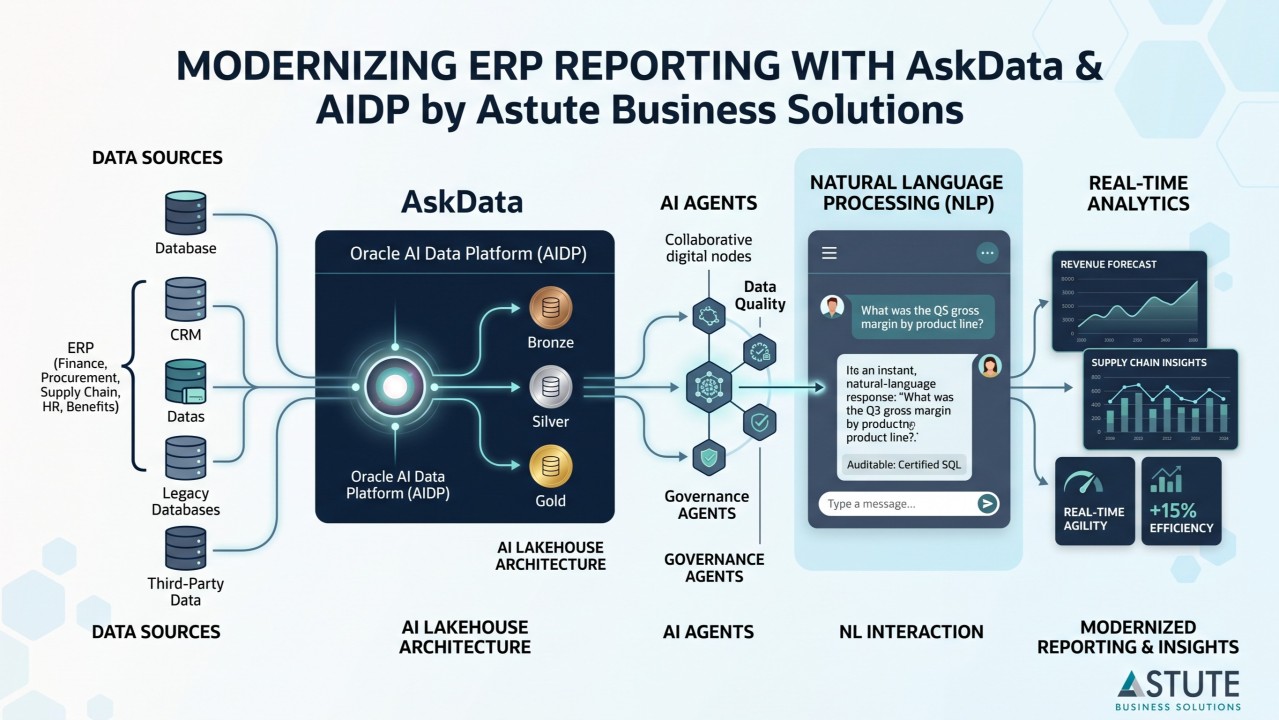
Conversational analytics lets authorized users ask questions about enterprise data in plain English.
For example:
- Which departments are exceeding their budgets?
- What caused a particular expense variance?
- Which invoices are awaiting approval?
- Where are reconciliation exceptions occurring?
AI-powered tools can interpret these questions and retrieve relevant information from connected enterprise data sources.
Astute AskData supports natural-language queries across structured and unstructured data, helping users access information without manually building complex queries.
AI can also assist with journal entry validation, anomaly detection, and reconciliation by identifying unusual transactions or mismatches that require review.
Business impact: Faster access to financial insights, reduced reporting effort, and more informed decisions.
3. Improve Healthcare Procurement and Inventory Planning
Hospitals depend on the timely availability of medical supplies, equipment, and essential materials.
But procurement and inventory teams often work with manual requisitions, static reorder levels, supplier delays, and large volumes of system-generated alerts.
This makes it difficult to prioritize the actions that matter most.
How AI helps
AI can support more proactive supply chain operations by:
- Reviewing historical consumption patterns to support demand forecasting.
- Recommending replenishment actions based on inventory requirements.
- Assisting with purchase request creation and validation.
- Flagging potential supplier delays and stockout risks.
- Prioritizing procurement exceptions for review.
For example, AI-assisted inventory planning can use historical consumption, seasonal patterns, and relevant operational information to recommend changes to replenishment levels.
Similarly, intelligent requisition workflows can help verify budgets, identify potential duplicate requests, and guide users toward preferred suppliers.
Human approval can remain part of purchasing decisions, especially for higher-risk transactions.
Business impact: Better inventory planning, less administrative work, and improved procurement visibility.
Your Healthcare ERP Can Do More with AI
From Finance and Supply Chain to HR, see how Astute can help identify practical AI opportunities within your existing enterprise systems.
4. Simplify Supplier Contracts and Compliance Reviews
Healthcare organizations manage supplier contracts, service agreements, insurance documents, and other compliance-related records.
Reviewing these documents manually can be time-consuming, particularly when teams need to locate specific clauses, track renewal dates, or verify supplier information.
Important details can be difficult to find when documents are stored across multiple systems.
How AI helps
AI-powered contract and document intelligence can assist teams with:
- Extracting contract terms, obligations, and important dates.
- Identifying missing clauses or potential contractual risks.
- Generating contract drafts using approved templates.
- Supporting contract review and approval workflows.
- Tracking upcoming renewals and compliance requirements.
AstuteCLM brings AI-assisted capabilities into contract creation, review, approval, and management workflows.
Intelligent document processing can also support supplier onboarding by extracting information from documents such as Certificates of Insurance and flagging items that need further verification.
These capabilities can reduce repetitive document handling while keeping appropriate reviews and approvals in place.
Business impact: Faster document reviews, improved contract visibility, and more consistent supplier compliance processes.
5. Automate Healthcare HR Onboarding and Employee Support
Healthcare HR departments manage employee onboarding, policy inquiries, documentation, and workforce-related requests.
With complex staffing requirements and large volumes of employee information, routine administrative tasks can consume considerable time.
New employees may need to submit multiple documents, while existing staff regularly request information about leave, benefits, payroll, or workplace policies.
How AI helps
AI can simplify HR operations through:
- Document Processing: Extracting and validating information from employee onboarding documents.
- Onboarding Automation: Supporting employee record creation and related workflows in existing HCM applications.
- Employee Self-Service: Helping employees access information about leave balances, benefits, and common HR requests.
- Policy Assistance: Finding relevant answers in employee handbooks and HR policy documents.
- Document Intelligence: Supporting searches across complex policy documents and collective bargaining agreements.
Astute's AI-powered HR onboarding capabilities can help reduce document-processing effort while integrating with existing HCM systems.
AI assistants can also make approved HR information easier to access, subject to appropriate user permissions and security controls.
Business impact: Less paperwork, more consistent onboarding, and faster access to employee information.
How Healthcare Organizations Can Get Started with AI
Adopting AI doesn't have to begin with a large technology transformation.
A practical approach is to identify one operational challenge and evaluate how AI could improve it.
Healthcare organizations can follow three steps:
1. Identify High-Value Opportunities
Review manual, document-heavy, or repetitive workflows across Finance, Supply Chain, and HR.
2. Start with a Focused Pilot
Select a specific use case, define measurable objectives, and evaluate the AI solution within the existing technology environment.
3. Expand Based on Results
Assess accuracy, processing efficiency, security, and user feedback before extending AI to additional workflows.
This phased approach helps organizations evaluate AI's business value while maintaining control over their existing applications and processes.
Modernize Healthcare Operations Without Replacing Your ERP
AI can do much more than answer employee questions or generate text. It can support invoice processing, financial reporting, purchasing decisions, contract management, and HR onboarding.
For healthcare organizations, the opportunity is to make essential business processes more efficient while continuing to build on existing ERP investments.
Astute Business Solutions helps organizations apply practical AI capabilities to enterprise workflows across Finance, Supply Chain, and HR, without requiring an immediate ERP replacement.
Your next healthcare breakthrough may not require a new ERP. It may start with making your existing operations work smarter.
Ready to identify where AI can make a difference?
Schedule an AI Consultation with Astute to discuss your healthcare ERP challenges and potential AI opportunities.

Arvind Rajan is Co-Founder and CEO of Astute Business Solutions. He is leading the expansion of Astute services to include Cloud Managed Services, Disaster Recovery on Cloud, and Integration and Process Automation using Platform Cloud Services.
Search
Related Posts


Subscribe Our Newsletter
Gain access to exclusive insights, technical know-how and crucial knowledge from Astute experts.
Share Article

See The Team In Action
Upcoming Events

- Accounts Payable - AP
- Higher Education
- AI Agents
- AI for ERP
- GenAI
Modernizing Accounts Payable: Built for Real Operations
Reach Out
Ready to Connect?
Please fill the following form, we will get back to you within a business day.
Contact Form
Contact Us