


Higher education institutions generate vast amounts of data across student information systems, learning management platforms, finance, human resources, advancement, enrollment, and student success applications. Yet much of this information remains fragmented across disconnected systems, making it difficult to create a complete, timely, and trusted view of the institution.
For institutions using platforms such as Ellucian Banner, Oracle PeopleSoft, Oracle Cloud applications, or other enterprise systems, this challenge has become increasingly visible. Legacy operational data stores, reporting databases, extracts, and custom integrations may continue to support important reporting needs, but growing demands for enterprise analytics, predictive modeling, artificial intelligence, and autonomous AI agents are prompting institutions to reconsider their long-term data architecture.
The question is no longer simply how to maintain existing reports. It is how to create a modern, governed data foundation that provides shared business context and semantic consistency to human leaders and AI agents alike.
The Challenge of Data Silos and Agent Sprawl
Higher education applications are typically designed around specific institutional functions. Student information systems manage academic progress. Learning management systems capture engagement. Enterprise systems track budgets, transactions, and employees. Advancement systems support fundraising and alumni engagement.
Each system serves an important purpose, but the data within these systems is often difficult to combine. As a result, institutions face:
- Conflicting metric definitions: Discrepancies in core definitions across departments, particularly regarding enrollment, retention, and student success.
- Integration debt: Proliferation of duplicate data extracts, fragile custom scripts, and heavy manual reconciliation between offices.
- Reporting latency: Delays in producing cross-functional dashboards and administrative reports.
- Agent sprawl and unmanaged risk: Decentralized deployment of chatbots and AI assistants lacking unified business context, resulting in hallucinated metrics, ungrounded answers, and uncoordinated access controls.
These challenges become acute when institutions deploy predictive analytics or autonomous workflows. Advanced AI capabilities depend on shared business context, semantic alignment, and deep data security. Without that foundation, AI can amplify institutional inconsistency rather than resolve it.
Rethinking the Role of Legacy Reporting Environments
For institutions that rely on an operational data store (ODS), legacy warehouse, or custom extract scripts, modernization begins with an objective dependency assessment. Before deciding to retire or replace any reporting component, leadership should evaluate:
- Which reports, scheduled jobs, and departmental workflows depend on legacy extracts.
- How institutional business rules and semantic definitions are documented and implemented.
- What historical data must be preserved for longitudinal and compliance reporting.
- Which workloads represent core operational transactions versus analytical and modeling tasks.
- Whether the current stack can enforce deep data security, audit AI-driven interactions, and govern cross-departmental AI agents.
Retiring legacy reporting components is not a simple lift-and-shift replacement. It represents an intentional migration toward an open, multicloud lakehouse and semantic data platform.
Building a Modern Foundation with Oracle AI Data Platform and Autonomous AI Lakehouse
Oracle AI Data Platform (AIDP) and the Autonomous AI Lakehouse provide an integrated foundation for institutional data, enterprise analytics, and governed AI workloads across the campus:
- AI-Generated, Human-Governed Business Ontologies: AIDP defines the standardized concepts, terminology, relationships, and policies across campus systems. Instead of AI models guessing meaning from raw column headers in Banner or PeopleSoft, ontologies ensure human analysts and autonomous agents interpret institutional data consistently.
- Autonomous AI Lakehouse & Business Semantic Layer: Provides a single, governed definition of university metrics across all departments, preventing divergent calculations of retention, credit load, and completions. Combined with the AI Data Catalog, it automates data discovery across Oracle and non-Oracle systems.
- Expanded Open Formats (Apache Iceberg) & Multicloud Reach: Supports open table formats in object storage with direct SQL querying, operating seamlessly across OCI, AWS, Microsoft Azure, Google Cloud, and dedicated environments.
- Unified Data Studio: A shared workspace for data engineers, institutional researchers, and analysts to prepare, integrate, and analyze campus data using SQL, Python, or natural language interfaces.
- Business Simulation Engine: Unifies historical analytics with forward-looking institutional scenario planning (e.g., modeling demographic shifts, tuition discounting, and state funding impacts on housing and academic budgets), reducing dependency on standalone planning software.
- AIDP Innovation Service: Oracle experts collaborate directly with university teams to design, validate, deploy, and operationalize custom analytics and AI architectures.
Domain Data Products
| Domain Data Product | Integrated Sources | Institutional Value & Impact |
|---|---|---|
| Student 360 & Advising | SIS (Banner/PeopleSoft), LMS (Canvas/Blackboard), Advising notes, Financial Aid | Enables proactive intervention triggers for at-risk students and provides advisors with holistic academic engagement profiles. |
| Enrollment & Retention Analytics | CRM (Slate/Salesforce), Admissions, Historical Registrations | Standardizes census tracking, predictive yield modeling, and retention forecasting across demographic cohorts. |
| Curriculum & Section Analytics | Course Catalogs, Scheduling engines, Classroom utilization records | Identifies degree completion bottlenecks, optimizes section scheduling, and balances faculty teaching loads. |
| Institutional Finance & Scenario Modeling | General Ledgers, Procurement, Student Accounts, Financial Aid | Combines accounting ledgers with the Business Simulation Engine for forward-looking tuition revenue and budget forecasting. |
| Workforce & Personnel Planning | HR systems, Payroll, Faculty Affairs data | Provides comprehensive insights on faculty turnover, departmental staffing ratios, and payroll commitments. |
| Advancement & Alumni Relations | Advancement platforms, Giving history, Alumni engagement data | Improves donor engagement, tracks campaign progress, and connects alumni career outcomes with institutional programs. |
The Medallion Architecture: From Raw Data to Autonomous Insight
The Medallion Architecture provides a structured framework that preserves data provenance while progressively applying business rules and governance:
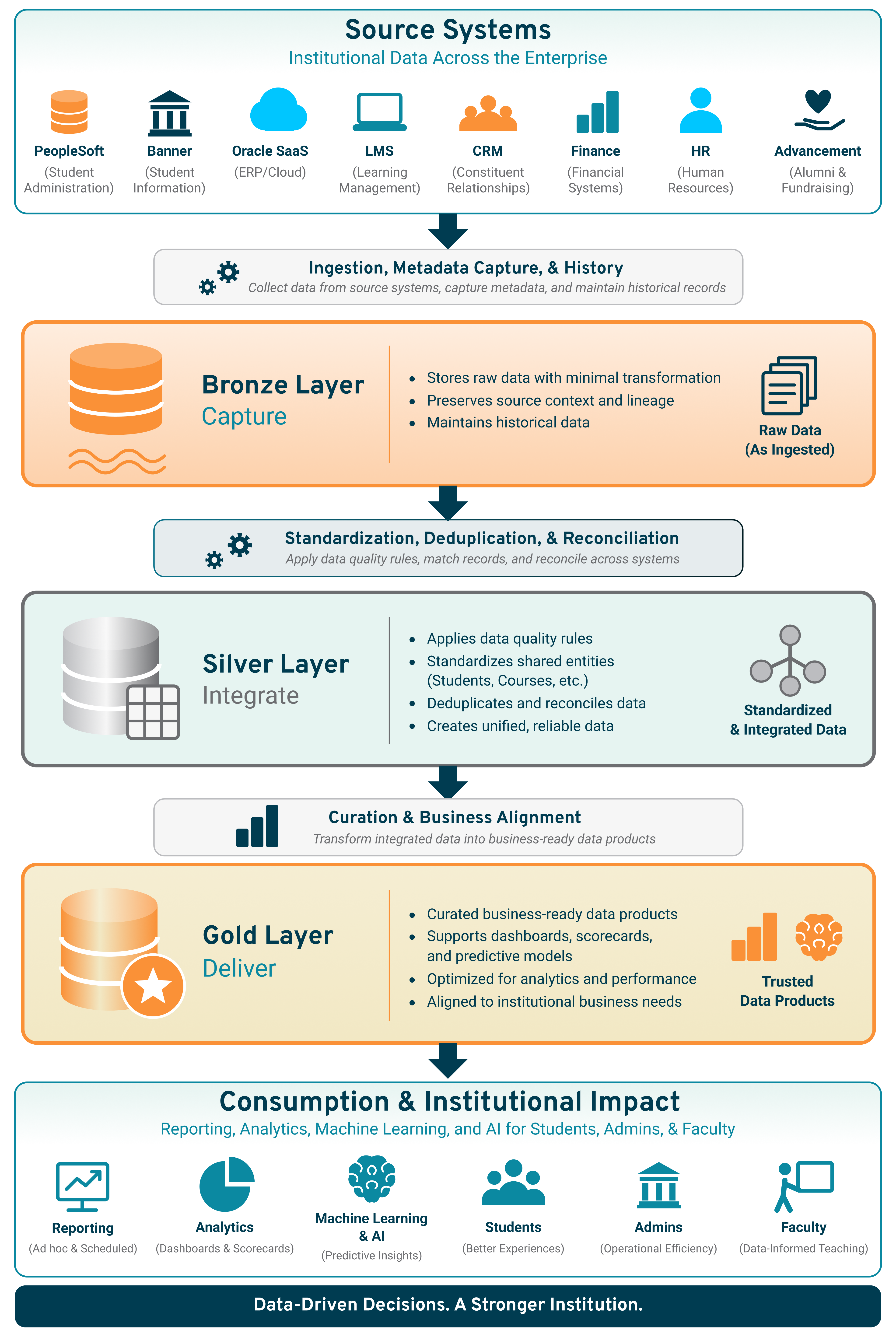
Bronze: Capturing Raw Source Data
The Bronze layer ingests data from disparate source systems with minimal alteration. Ingesting into open table formats like Apache Iceberg preserves source fidelity, ensures point-in-time recovery, and establishes an auditable starting point without forcing early schema constraints.
Silver: Standardizing and Integrating Data
The Silver layer resolves discrepancies across systems by enforcing quality rules, deduplicating records, and linking entity identities (e.g., matching a person across HR employee records, registrar transcripts, and advancement profiles). Guided by AI-generated ontologies and the AI Data Catalog, Silver provides a clean, unified enterprise layer while respecting domain security rules.
Gold: Delivering Business-Ready Data
The Gold layer presents curated data products governed by the Business Semantic Layer. Because terms and metrics are centrally validated, BI dashboards, natural-language interfaces, and autonomous student advising bots operate against verified definitions rather than ambiguous raw tables.
Deep Trust AI Architecture: Security, Privacy, and Governance
Higher education manages highly sensitive personal, academic, financial, and research data. Accessibility without security compromises trust. Oracle Deep Trust AI Architecture embeds controls directly into the infrastructure across three core tiers:
- Deep Data Security: Enforces FERPA, HIPAA, and role-based policies directly inside database engines. Regardless of how an AI prompt is phrased, the database rejects queries that exceed the user's explicit entitlements.
- Deep Trust Data APIs: Limits agent communication pathways to prevent unauthorized data scraping or context leakage across administrative boundaries.
- AI Estate Governance: Provides university CIOs and compliance officers centralized oversight over active agents, retiring rogue models and mandating human approval for high-consequence academic decisions.
Enabling Modern Campus Experiences
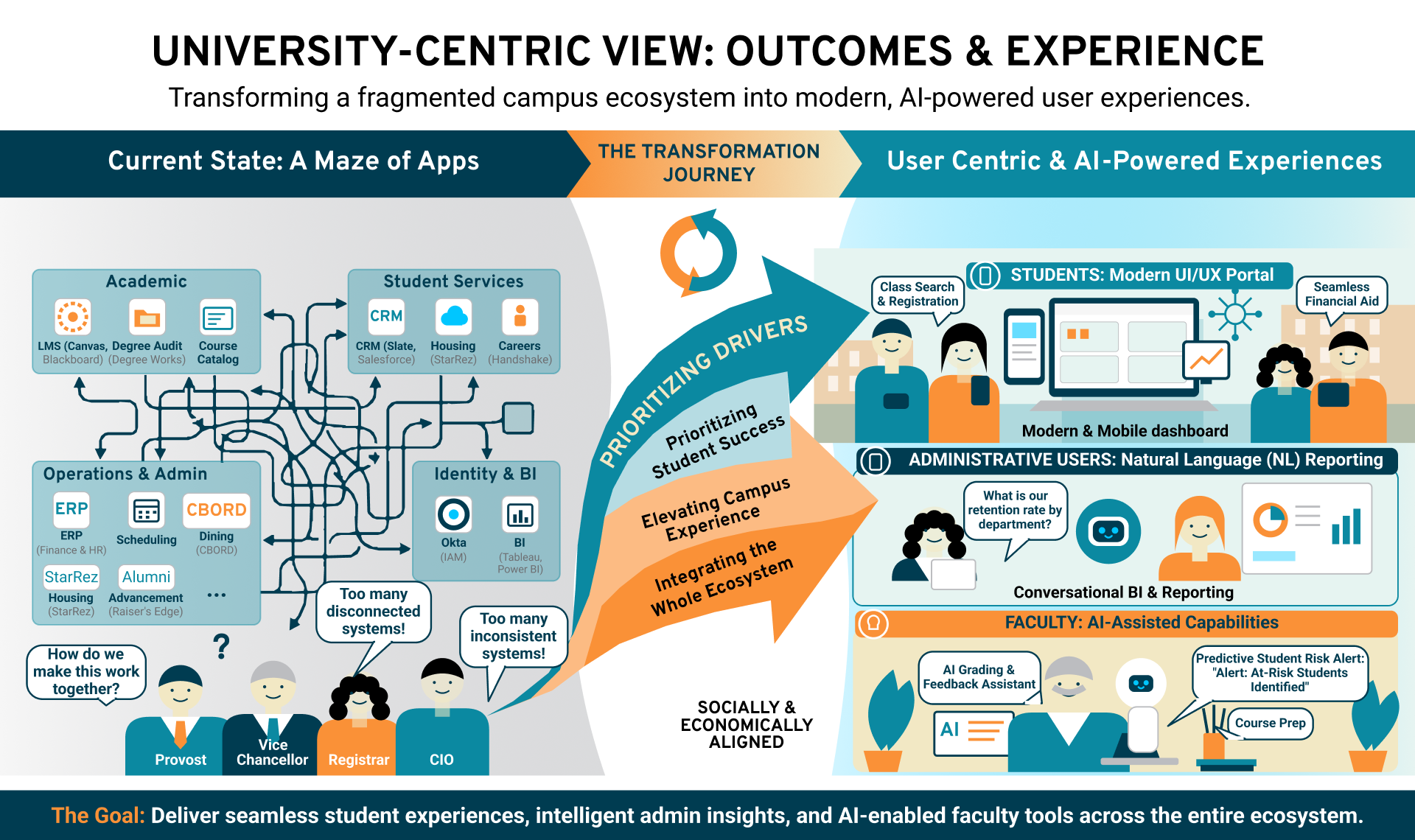
An integrated, semantically governed data foundation transforms daily interactions across all stakeholder groups:
- Students: Benefit from unified portals and conversational assistants grounded in validated policy and catalog documents, offering clear degree roadmaps, transparent financial aid counseling, and seamless administrative support.
- Administrators: Leverage natural-language querying for operational reporting, receiving consistent answers that align precisely across institutional research, finance, and admissions.
- Faculty: Use AI tools for formative grading assistance, course prep, and proactive risk detection while relying on enterprise-grade privacy protections for instructional data.
- Executive Leadership: Utilize the Business Simulation Engine to project the long-term impact of demographic shifts, tuition policy changes, and enrollment swings on the university's financial sustainability.
A Practical Modernization Roadmap
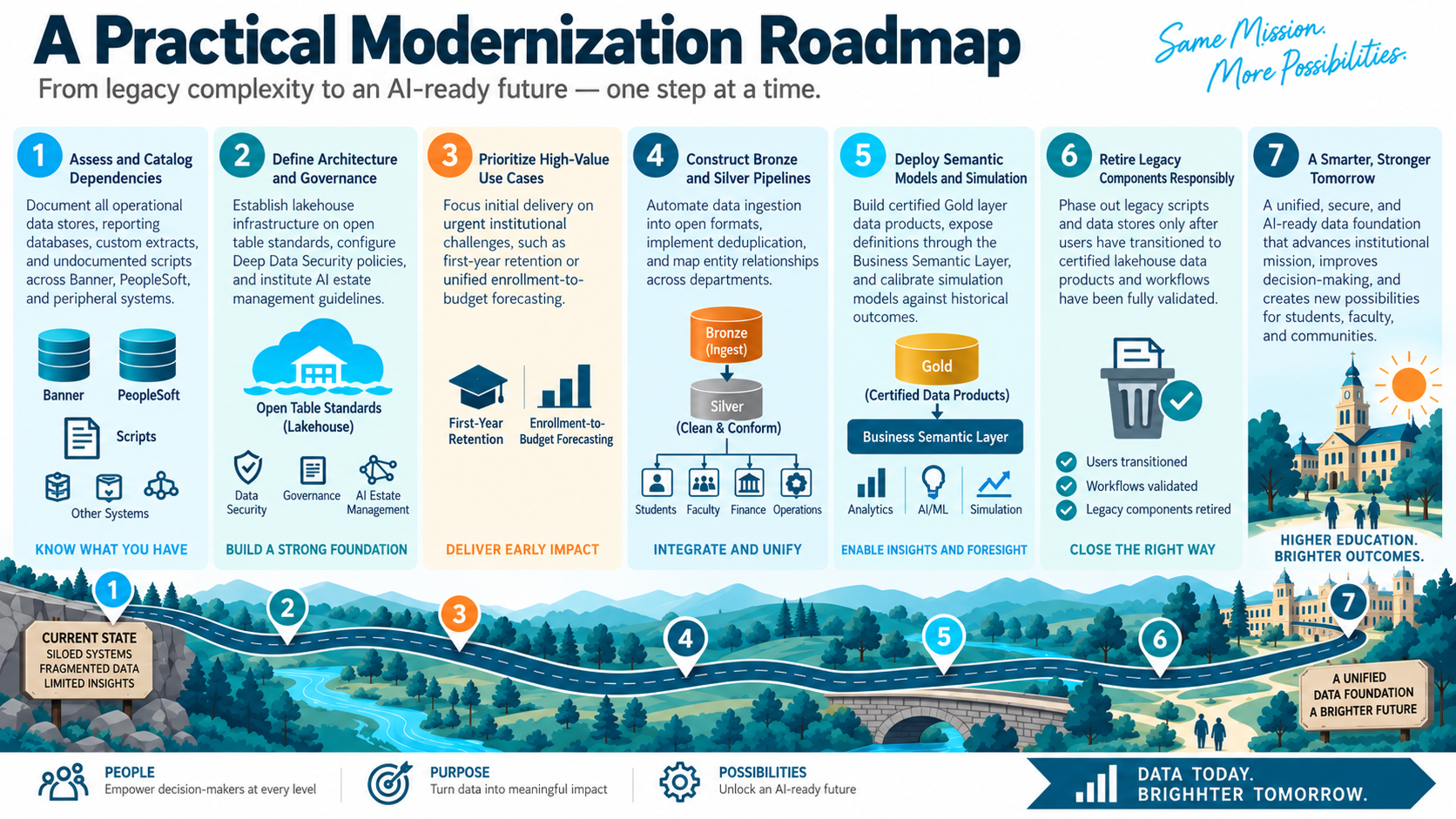
- Assess and Catalog Dependencies: Document all operational data stores, reporting databases, custom extracts, and undocumented scripts across Banner, PeopleSoft, and peripheral systems.
- Define Architecture and Governance: Establish lakehouse infrastructure on open table standards, configure Deep Data Security policies, and institute AI estate management guidelines.
- Prioritize High-Value Use Cases: Focus initial delivery on urgent institutional challenges, such as first-year retention or unified enrollment-to-budget forecasting.
- Construct Bronze and Silver Pipelines: Automate data ingestion into open formats, implement deduplication, and map entity relationships across departments.
- Deploy Semantic Models and Simulation: Build certified Gold layer data products, expose definitions through the Business Semantic Layer, and calibrate simulation models against historical outcomes.
- Retire Legacy Components Responsibly: Phase out legacy scripts and data stores only after users have transitioned to certified lakehouse data products and workflows have been fully validated.
Measuring Institutional Success
A modern data strategy must deliver demonstrable educational and operational value:
- Metric Uniformity: Elimination of conflicting cross-departmental figures for retention, enrollment, and institutional expenditures.
- Accelerated Time-to-Insight: Faster release cycles for new data products using Data Studio and automated data catalogs.
- Responsible Agent Adoption: Full compliance visibility, audited interactions, and zero security policy leaks across all campus AI implementations.
- Timely Student Interventions: Shorter turnaround times between initial risk signals and student support actions.
- Strategic Scenario Agility: Rapid modeling of tuition, demographic, and funding scenarios that enable informed, proactive campus leadership.
Modernization is more than upgrading legacy technology. By combining a Medallion Architecture with the business context, semantic governance, and deep trust security of Oracle AI Data Platform and Autonomous AI Lakehouse, universities can establish a resilient data foundation built to support the future of higher education.


See The Team In Action
Upcoming Events

- Accounts Payable - AP
- Higher Education
- AI Agents
- AI for ERP
- GenAI