PeopleSoft continues to support critical enterprise processes across finance, HR, procurement, campus, and administration. For many organizations, it remains a stable and trusted system of record that manages high-value operational data and daily transactions.
But enterprise expectations have changed.
Leaders now need faster access to information, more responsive workflows, stronger reliability, better operational visibility, and less dependence on manual effort. Stability remains important, but organizations are also looking for practical ways to help PeopleSoft-supported teams work faster and make smarter decisions.That is why PeopleSoft AI readiness is becoming a practical next step in ERP modernization.
That is why PeopleSoft AI readiness is becoming a practical next step in ERP modernization.
The goal is not to replace PeopleSoft. The goal is to extend its value by improving how teams use PeopleSoft data, workflows, documents, and infrastructure to support daily operations with greater speed, visibility, and confidence.
PeopleSoft Modernization Is Moving Beyond Maintenance
Many PeopleSoft environments are mature, reliable, and deeply connected to enterprise operations. However, teams often continue to rely on manual processes around the ERP system.
Common challenges include:
- Manual approval follow-ups
- Spreadsheet-based reporting
- Email-driven coordination
- Time-consuming document review
- Repetitive data entry
- Limited self-service access to operational information
- Slow visibility into workflow bottlenecks
These challenges do not always come from PeopleSoft itself. They often come from the processes surrounding it.
For example, a finance team may use PeopleSoft for core AP transactions but still rely on manual invoice review before data enters the workflow. An HR team may store employee information in PeopleSoft but depend on staff to answer repeated policy or status questions. A procurement team may have supplier and PO data available but still spend time searching across records, documents, and approvals.
AI can help close these gaps in a practical, targeted way.
What AI Readiness Means for PeopleSoft
AI readiness does not mean adding AI everywhere at once. It means creating the right foundation to apply AI where it can improve productivity, visibility, and decision-making.
For PeopleSoft organizations, this often includes four priorities.
First, data must be accessible. Users need faster ways to retrieve information from transactions, records, approvals, and documents.
Second, workflows must be more responsive. Processes should reduce manual routing, follow-ups, and repetitive administrative steps.
Third, documents must become easier to process. Invoices, forms, supplier documents, HR files, and administrative records should move into structured workflows with less manual effort.
Fourth, infrastructure must support modern AI services. Oracle Cloud Infrastructure can play an important role by giving PeopleSoft environments a scalable foundation for performance, resilience, reliability, automation, and AI adoption.
When these elements come together, PeopleSoft can support a more intelligent and productive operating model.
How AI Can Improve PeopleSoft-Supported Operations
AI is most valuable when it solves real operational problems. For PeopleSoft teams, the strongest use cases are often practical, targeted, and measurable.
Conversational Reporting and Insights
Many users need answers from PeopleSoft data but do not want to navigate complex reports or wait for technical support.
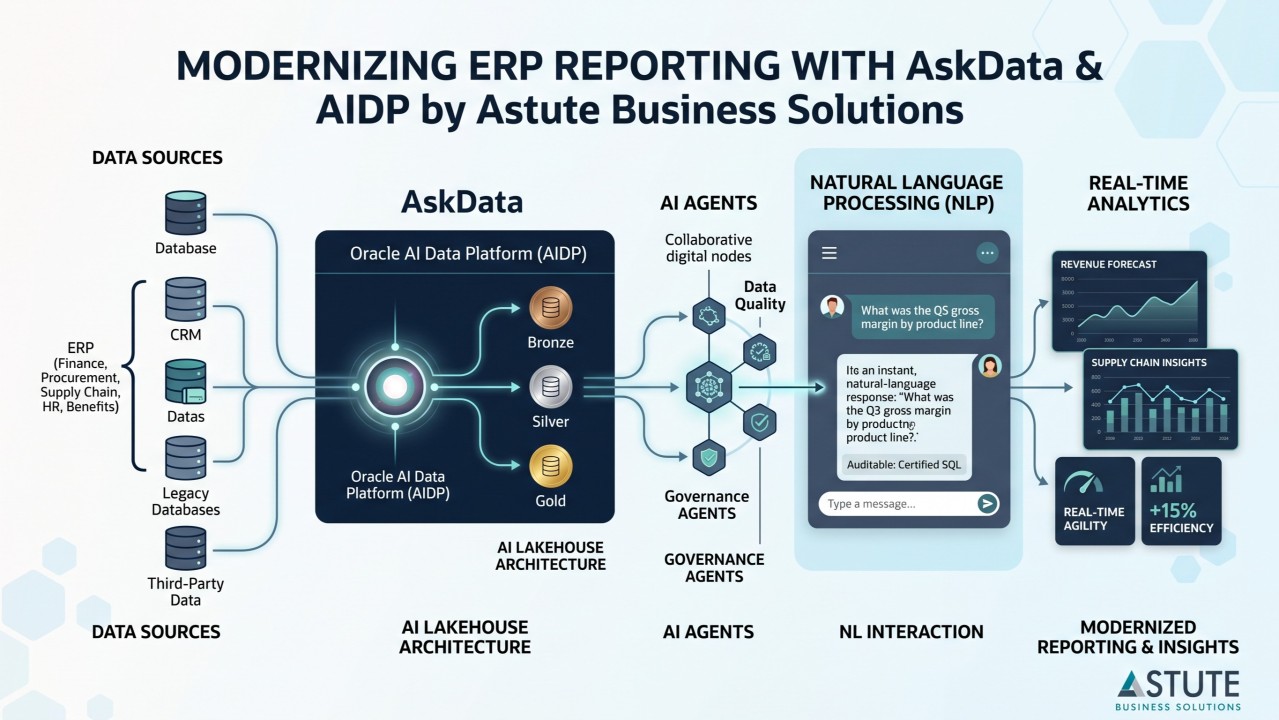
Conversational reporting allows users to ask natural-language questions and retrieve insights from operational data. Instead of requesting a custom report, a finance leader may ask about invoice status, a procurement manager may review supplier activity, or an HR leader may explore workforce-related trends.
This improves access to information and helps teams make faster, better-informed decisions.
AI-Powered Search Across ERP Operations
PeopleSoft environments contain large volumes of records, transactions, approvals, documents, and workflow activity. Finding the right information can take time, especially for users who do not work inside the system every day.
AI-powered search helps users locate information faster across PeopleSoft-supported processes. This can reduce navigation complexity, improve productivity, and make ERP data easier to use across departments.
Intelligent Document Processing
Document-heavy processes remain a major source of manual work. Finance, HR, procurement, and administrative teams often spend time reviewing, extracting, validating, and routing document data.
Intelligent Document Processing can help automate these steps. AI can extract relevant information, validate it against business rules, and route it into the right workflow. This reduces manual effort and supports cleaner processing inside the ERP environment.
Agentic AI for Workflow Support
As enterprise workflows become more complex, organizations need systems that can support better task routing, exception handling, and process recommendations.
Agentic AI can help PeopleSoft workflows become more responsive by assisting with task prioritization, routing, and decision support. This does not remove governance or business oversight. It helps teams manage work more efficiently within existing business rules.
OCI as the Foundation for AI-Ready PeopleSoft
AI adoption requires more than use cases. It also requires infrastructure that can support performance, scalability, security, reliability, and integration.
Modernizing PeopleSoft on Oracle Cloud Infrastructure helps organizations create a stronger foundation for AI-enabled ERP services. OCI can support cloud performance, automation, security controls, disaster recovery strategies, and integration with Oracle AI services.
For organizations planning long-term PeopleSoft modernization, OCI provides a practical path to strengthen the environment while preserving the ERP investment.
The Business Value of AI-Ready PeopleSoft
The value of AI readiness is not just technical. It helps teams improve daily work across departments.
Organizations can benefit from:
- Faster access to operational insights
- Reduced manual processing
- Improved approval visibility
- Better document handling
- More consistent workflows
- Greater user productivity
- Stronger ERP performance on cloud infrastructure
- A clearer roadmap for future AI adoption
For leaders, the result is a PeopleSoft environment that continues to serve as a trusted system of record while becoming easier to search, automate, and use for smarter decisions.
How Astute Helps Organizations Prepare PeopleSoft for AI
Astute helps organizations enhance PeopleSoft with AI-driven automation, conversational insights, intelligent document processing, enterprise search, Agentic AI, and OCI-based modernization.
Our approach focuses on practical modernization rather than disruptive replacement. We help organizations identify where AI can reduce manual effort, improve visibility, strengthen reliability, and support smarter decisions inside existing ERP environments.
Astute brings experience across PeopleSoft, Oracle Cloud Infrastructure, ERP integration, AI for ERP, and enterprise modernization. With more than 20 years in business, 10+ AI for ERP projects, 75+ cloud projects, and 150+ on-premises projects, Astute understands how to support complex ERP environments while helping organizations move toward modern AI-enabled operations.
Prepare PeopleSoft for the Next Stage of Enterprise AI
PeopleSoft remains a valuable enterprise platform. But the way organizations use it must continue to evolve.
By improving data access, automating manual workflows, modernizing infrastructure, and applying AI to practical use cases, organizations can make PeopleSoft more responsive to today’s business demands.
AI-ready PeopleSoft helps teams reduce manual effort, improve visibility, strengthen reliability, and make faster, better-informed decisions across the enterprise.
Ready to identify where AI can improve your PeopleSoft environment?
Schedule a PeopleSoft AI Readiness Session with Astute



.svg)


.svg)




.svg)

-2.svg)
-1.svg)


.svg)


.svg)
.svg)
.svg)

.svg)

.svg)
.svg)


.svg)

.svg)
.svg)
.svg)
.svg)
.svg)
.svg)
.svg)
.svg)
.svg)


.svg)
.svg)
.svg)
.svg)


.svg)
-1.svg)
.svg)
.svg)
.svg)

.svg)
.svg)

.svg)
.svg)

.svg)
.svg)
.svg)
.svg)
.svg)
.svg)
.svg)



.svg)