Higher education institutions are under growing pressure to modernize core systems while maintaining uninterrupted campus operations. Student systems, finance platforms, and administrative workflows must remain consistently available, even as institutions adopt digital experiences, analytics, and emerging technologies.
For many universities, Ellucian Banner remains central to these operations. However, when Banner runs in a legacy on-premises environment, it often becomes a constraint rather than an enabler. Performance limitations, operational complexity, and rising infrastructure costs make it difficult to support evolving institutional needs.
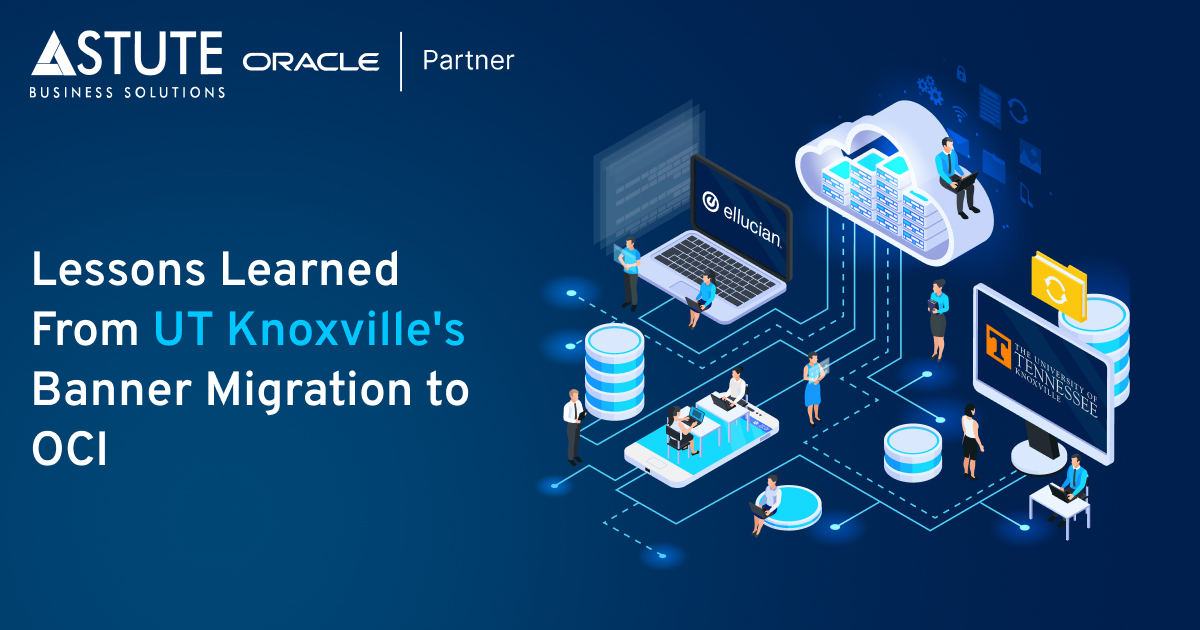
The University of Tennessee, Knoxville approached this challenge with a clear objective: modernize Banner without disrupting campus operations. In partnership with Astute Business Solutions, UTK successfully migrated its Banner environment to Oracle Cloud Infrastructure, achieving measurable improvements in performance, security, and scalability.
This blog outlines the key lessons learned from UT Knoxville’s Banner migration to OCI and how other institutions can apply them.
Lesson 1: Legacy Banner Environments Limit Growth More Than Expected
Many institutions recognize the need to modernize, but the full impact of legacy infrastructure is often underestimated.
In on-premises Banner environments, infrastructure rigidity limits scalability during peak academic cycles. Performance tuning becomes reactive rather than strategic. Disaster recovery depends on physical data centers, increasing both complexity and cost.
Operational processes are also heavily manual. Routine tasks such as patching, monitoring, and system updates require continuous intervention, increasing administrative overhead and the risk of human error.
UTK faced these same challenges. The institution needed a solution that would remove these limitations without introducing operational risk.
Key takeaway: Legacy Banner environments do more than slow performance. They restrict innovation, increase operational burden, and delay strategic initiatives across the institution.
Lesson 2: Migration Success Depends on Planning and Execution
A common misconception is that cloud migration is primarily a technology decision. UTK’s experience shows that execution is the defining factor.
Astute Business Solutions worked with UTK to develop a structured migration strategy focused on stability, validation, and controlled deployment. Each phase of the migration was carefully planned and tested before production cutover.
The approach included:
- A high-availability Banner architecture designed for Oracle Cloud Infrastructure
- Automated deployment and operational workflows using OCI-native tools
- Performance testing and validation to ensure system responsiveness
- Disaster recovery aligned with institutional continuity requirements
- A controlled cutover plan to eliminate disruption
- Post go-live support to ensure system stability
Extensive rehearsal cycles played a critical role. Instead of relying on a single migration event, the team validated each step in advance.
Key takeaway: A structured migration approach with multiple validation cycles is essential to achieving minimal disruption in higher education environments
Lesson 3: Platform Choice Directly Impacts Outcomes
Selecting the right cloud platform is not just a technical decision. It determines how effectively institutions can scale, secure, and operate their systems.
Oracle Cloud Infrastructure provides capabilities that align closely with enterprise application requirements in higher education. For UTK, OCI enabled a transition from reactive infrastructure management to a scalable and performance-driven environment.
Key advantages included:
- High-performance compute and storage for critical workloads
- Built-in monitoring and encryption to strengthen security
- Automated failover to improve system availability
- Flexible scaling to support peak academic demand
- Native tools that enable automation and operational efficiency
By aligning platform capabilities with institutional needs, UTK ensured that the migration delivered both immediate and long-term value.
Key takeaway: Platform selection plays a critical role in determining the success and sustainability of a cloud migration strategy.
Lesson 4: Measurable Outcomes Validate the Migration Strategy
The success of any migration is ultimately measured by outcomes. UTK’s move to OCI delivered improvements across performance, reliability, security, and operations.
Performance and User Experience
System response times improved across student and administrative workflows. Faster access to information enhanced overall campus efficiency.
Lesson: Performance gains are one of the most immediate indicators of modernization success.
Availability and Reliability
The high-availability architecture, combined with automated failover, reduced the risk of downtime.
Lesson: Availability must be designed into the system architecture from the start, not added later.
Security and Compliance
Built-in monitoring, encryption, and security controls strengthened data protection and compliance readiness.
Lesson: Cloud-native security capabilities provide a stronger and more consistent security posture.
Operational Efficiency
Automation reduced manual intervention, allowing IT teams to focus on strategic initiatives.
Lesson: Automation is essential for reducing operational overhead and improving consistency.
Scalability
On-demand resource scaling allowed UTK to handle peak periods without performance degradation.
Lesson: Scalability is critical for institutions with fluctuating workloads tied to academic cycles.
Strategic Readiness
The new environment supports future initiatives in AI, analytics, and digital transformation.
Lesson: Cloud migration should be viewed as a foundation for future innovation, not just infrastructure modernization.
Lesson 5: Partner Expertise Significantly Reduces Risk
Migration projects involve multiple layers of complexity, including application architecture, infrastructure design, and institutional workflows.
UTK’s success was supported by Astute Business Solutions’ expertise in Banner, Oracle Cloud Infrastructure, and higher education environments. This combination ensured that decisions were aligned with both technical and operational requirements.
Key takeaway: Working with a partner that understands both the application and the industry reduces risk and accelerates successful outcomes.
Lesson 6: Modernization Should Extend Beyond Migration
Cloud migration is often treated as an endpoint. UTK’s experience shows that it should be treated as a starting point.
With Banner running on OCI, UTK now has a platform that supports advanced analytics, automation, and AI-driven initiatives. This creates new opportunities for improving student services, administrative efficiency, and data-driven decision-making.
Key takeaway: Institutions should plan migration as part of a broader modernization strategy that includes future capabilities.
Why This Matters for Higher Education Now
Higher education institutions are balancing operational demands with increasing expectations for digital transformation. Legacy systems make it difficult to meet these expectations.
UTK’s migration demonstrates that modernization can be achieved without disruption when approached with the right strategy, platform, and execution model.
Institutions that take a structured approach to migration can reduce risk, improve performance, and position themselves for long-term innovation.
Conclusion: A Practical Blueprint for Banner Modernization
The University of Tennessee, Knoxville, provides a clear example of how Banner modernization can be successfully executed.
The key lessons are clear:
- Legacy environments limit both performance and innovation
- Execution is more important than technology selection
- Platform choice directly impacts outcomes
- Measurable improvements validate the migration approach
- Partner expertise reduces complexity and risk
- Migration should enable future innovation, not just infrastructure change
For higher education leaders, the path forward is not about replacing systems, but about modernizing them in a way that supports both current operations and future goals.
Astute Business Solutions continues to work with institutions to deliver this balance, helping them move from legacy constraints to a more scalable and future-ready environment.



.svg)


.svg)




.svg)

-2.svg)
-1.svg)


.svg)


.svg)
.svg)
.svg)

.svg)

.svg)
.svg)


.svg)

.svg)
.svg)
.svg)
.svg)
.svg)
.svg)
.svg)
.svg)
.svg)


.svg)
.svg)
.svg)
.svg)


.svg)
-1.svg)
.svg)
.svg)
.svg)

.svg)
.svg)

.svg)
.svg)

.svg)
.svg)
.svg)
.svg)
.svg)
.svg)
.svg)



.svg)