For years, the conversation about moving JD Edwards (JDE) to the cloud focused on infrastructure. IT leaders looked at reducing data center footprints, swapping capital expenses for operational ones, and improving disaster recovery. While those benefits remain valid, the primary motivation for migration in 2026 has shifted.
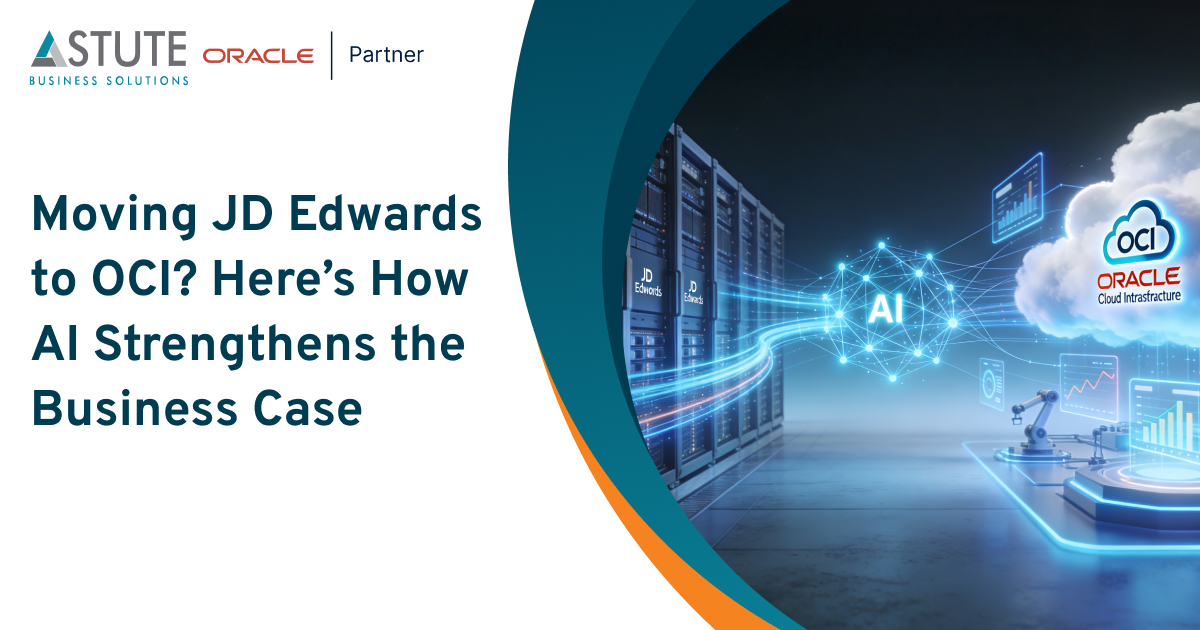
Cloud migration is no longer just about where your data lives. It is about what your data is capable of doing. Moving JD Edwards to Oracle Cloud Infrastructure (OCI) is now a foundational requirement for any organization that intends to build a more intelligent, autonomous enterprise. AI provides the strongest justification for an OCI business case by turning a system of record into a system of intelligence.
The Shift from Infrastructure to Intelligence
On-premises environments often face significant barriers when attempting to implement modern AI. High latency, security hurdles, and the sheer processing power required to run large language models make it difficult to connect ERP data to intelligent services. OCI changes this dynamic by providing a native ecosystem where AI and JD Edwards coexist on the same high-performance fabric.
When JDE runs on OCI, it gains direct access to the Oracle AI stack. This includes pre-trained models for document understanding, vision, language, and generative AI. These services do not require a separate integration project or complex middleware. They are ready to be utilized through the JD Edwards Orchestrator, allowing your team to build intelligent workflows that were previously impossible in a traditional data center.
Strengthening the Business Case with Practical AI Use Cases
To build a compelling business case for leadership, you must move beyond technical specifications and focus on business outcomes. Here is how AI on OCI creates measurable value across the organization.
1. Processing Unstructured Data at Scale
A major drain on productivity in JD Edwards environments is the manual handling of unstructured data. Invoices, receipts, bills of lading, and contracts often arrive as PDFs or images that require human intervention to enter into JDE.
By migrating to OCI, you can utilize OCI Document Understanding. This AI service uses machine learning to read and interpret documents without the need for rigid templates. When paired with AstuteAP, this process becomes even more effective. AstuteAP uses AI to read invoices, validate fields against JDE data, match purchase orders, and flag duplicates automatically. Organizations using these AI-driven solutions report a reduction in manual data entry of up to 80%, significantly lowering the cost per transaction.
2. Enhancing the User Experience with Conversational AI
The complexity of JD Edwards menus and reports can be a barrier to efficiency for casual users. Sales representatives, field technicians, and executives often need quick answers but do not have the time to navigate multiple screens or wait for a custom report from the IT team.
OCI provides the infrastructure for Generative AI Agents that can interact with JDE data using natural language. This is where solutions like AskData for JD Edwards provide immediate value. AskData allows users to speak or type questions such as, “What is our current inventory for SKU 10234?” or “Which supplier invoices are pending approval?”. The AI retrieves the answer instantly from JDE, providing a more intuitive way for employees to interact with the ERP. This reduces the burden on help desks and allows teams to make faster decisions.
3. Moving from Reactive to Predictive Operations
Traditional ERP systems are reactive; they tell you what happened yesterday or last month. Moving to OCI allows you to use AI to predict what will happen tomorrow.
With the high-performance computing power of OCI, you can run machine learning models against years of historical JDE data to identify patterns.
- Supply Chain: AI can analyze lead times and carrier performance to predict potential delays before they impact your customers.
- Maintenance: For manufacturers, AI can monitor equipment telemetry to predict failures, allowing for repairs during planned downtime rather than emergency shutdowns.
- Finance: AI-driven cash flow forecasting can analyze payment patterns to provide a more accurate picture of working capital.
4. Autonomous Security and Performance
Maintaining a JD Edwards environment on-premises requires a significant amount of manual effort from CNC and database administrators. This "keeping the lights on" work takes away from time that could be spent on innovation.
OCI’s Autonomous Database uses AI to handle its own patching, tuning, and security updates without downtime. Furthermore, AI-driven security services on OCI monitor for unusual access patterns or potential threats in real time, providing a layer of protection that is difficult to achieve in a private environment. This reduces operational risk and ensures that your most critical business data remains secure.
The Role of Astute Business Solutions in Your Migration
Migrating to OCI is a significant step, but it is one that does not have to be done alone. Astute Business Solutions specializes in helping JD Edwards customers move to the cloud while simultaneously introducing AI-driven efficiency.
Astute provides a clear path for modernization that keeps your core system stable while adding new capabilities. Whether you are looking to automate your accounts payable with AstuteAP, improve reporting with AskData, or manage complex contracts with AstuteCLM, these solutions are designed to work natively with JD Edwards on OCI.
By working with an experienced partner, you can ensure that your migration is not just a change in hosting, but a move toward a more intelligent way of working. Astute helps you identify the high-impact use cases that will deliver the fastest return on investment, allowing you to prove the value of the cloud to your stakeholders quickly.
Financial Justification: ROI Beyond Cost Savings
When presenting the business case for JDE on OCI, it is important to emphasize that the return on investment comes from three distinct areas:
- Infrastructure Savings: Lowering the total cost of ownership by eliminating hardware refreshes and reducing energy and floor space costs.
- Productivity Gains: Reducing the hours spent on manual tasks like data entry, report generation, and system maintenance through AI automation.
- Strategic Value: Enabling faster decision-making and better customer service through real-time insights and predictive analytics.
Combining these three factors creates a business case that is about growth and agility, not just cost reduction.
Conclusion
The decision to move JD Edwards to OCI is the most important choice a CIO will make for their ERP strategy in 2026. It is the move that makes everything else possible. Without the cloud, your organization remains tied to manual processes and reactive data. On OCI, your JD Edwards environment becomes the intelligent heart of your business.
By leveraging AI to automate the mundane, predict the future, and provide data-driven insights, you are doing more than just modernizing your technology. You are providing your team with the tools they need to succeed in a more competitive and fast-paced market.
Is your organization ready to build a more intelligent JD Edwards environment?
This post is Part 2 of our comprehensive series on the future of JD Edwards. If you missed the start of our series, be sure to read Part 1 — AI for JD Edwards: 6 High-Impact Use Cases Every CIO Should Prioritize in 2026, where we lay the foundation for how artificial intelligence is becoming the standard for modern ERP operations. Stay tuned for our next installment, where we will explore the practical realities of Finance Transformation and whether JD Edwards accounts payable can truly become touchless.



.svg)


.svg)




.svg)

-2.svg)
-1.svg)


.svg)


.svg)
.svg)
.svg)

.svg)

.svg)
.svg)


.svg)

.svg)
.svg)
.svg)
.svg)
.svg)
.svg)
.svg)
.svg)
.svg)


.svg)
.svg)
.svg)
.svg)


.svg)
-1.svg)
.svg)
.svg)
.svg)

.svg)
.svg)

.svg)
.svg)

.svg)
.svg)
.svg)
.svg)
.svg)
.svg)
.svg)





.svg)