


For decades, enterprise data architectures evolved around a fundamental constraint: storage was expensive, compute was tightly coupled to hardware, and schemas had to be rigidly defined before any data could be loaded. Organizations built on-premises data warehouses using extract, transform, and load (ETL) batch pipelines, consolidating data into structured star or snowflake schemas to feed static presentation layers, OLAP cubes, and proprietary business intelligence (BI) dashboards.
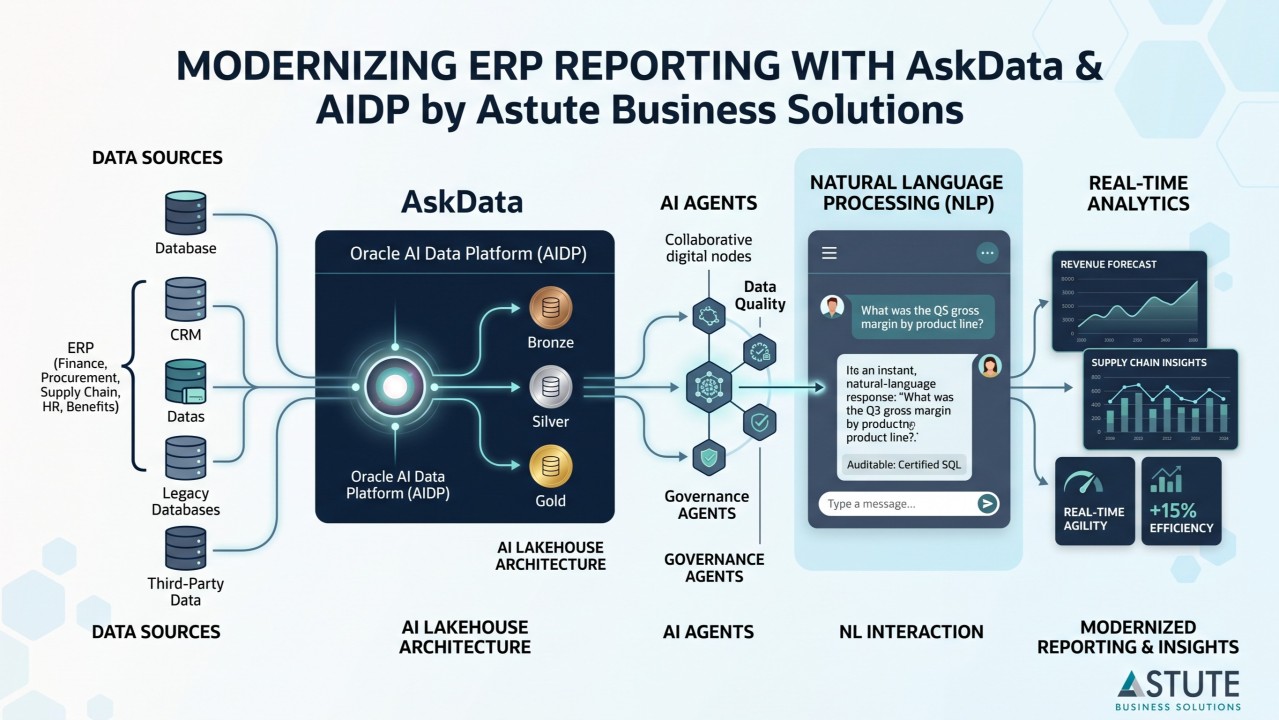
When cloud data lakes and first-generation lakehouses emerged (circa 2020–2024), they decoupled storage from compute, storing massive volumes of structured, semi-structured, and unstructured files in object storage (e.g., Parquet on Amazon S3). However, these early lakehouse deployments remained passive analytical repositories. They carried forward copy-heavy ETL pipelines (raw Bronze → cleaned Silver → aggregated Gold), relied on static Hive-style partitioning, and separated machine learning notebooks from BI SQL engines.
The modern Autonomous AI Lakehouse fundamentally disrupts both paradigms. Instead of merely storing data for human reporting, the lakehouse becomes an active, governed decision backbone that powers enterprise AI agents and business workflows. This transition is enabled by five core architectural breakthroughs:
-
Universal Open Table Formats: Standardizing on Apache Iceberg (V2/V3) with ACID transactions, schema evolution, hidden partitioning, time travel, and Puffin file statistics.
-
Federated REST Catalogs & Zero-Copy Federation: AI Data Catalogs (built on open cores like Apache Polaris) that mount existing databases, object stores, and third-party catalogs (AWS Glue, Databricks Unity, Snowflake Horizon, Microsoft Purview) without moving or duplicating underlying data.
-
Active Business Semantic Layers & Ontologies: Transforming raw technical schemas into shared, AI-interpretable business context (capturing metrics, hierarchies, KPIs, and operational constraints).
-
Deterministic, Knowledge-Driven NL2SQL: Replacing hallucination-prone, one-shot SQL generation with deep reasoning, business knowledge graphs, human-in-the-loop clarification, and regression testing.
-
Converged In-Database Execution & Agent Engines: Running relational SQL, vector search ("Vectors on Ice"), multidimensional what-if simulations, and declarative agent workflows directly within the database engine rather than external, disconnected orchestration layers.
The Leapfrog Journey: Reinventing Legacy Warehouses into Modern AI Lakehouses
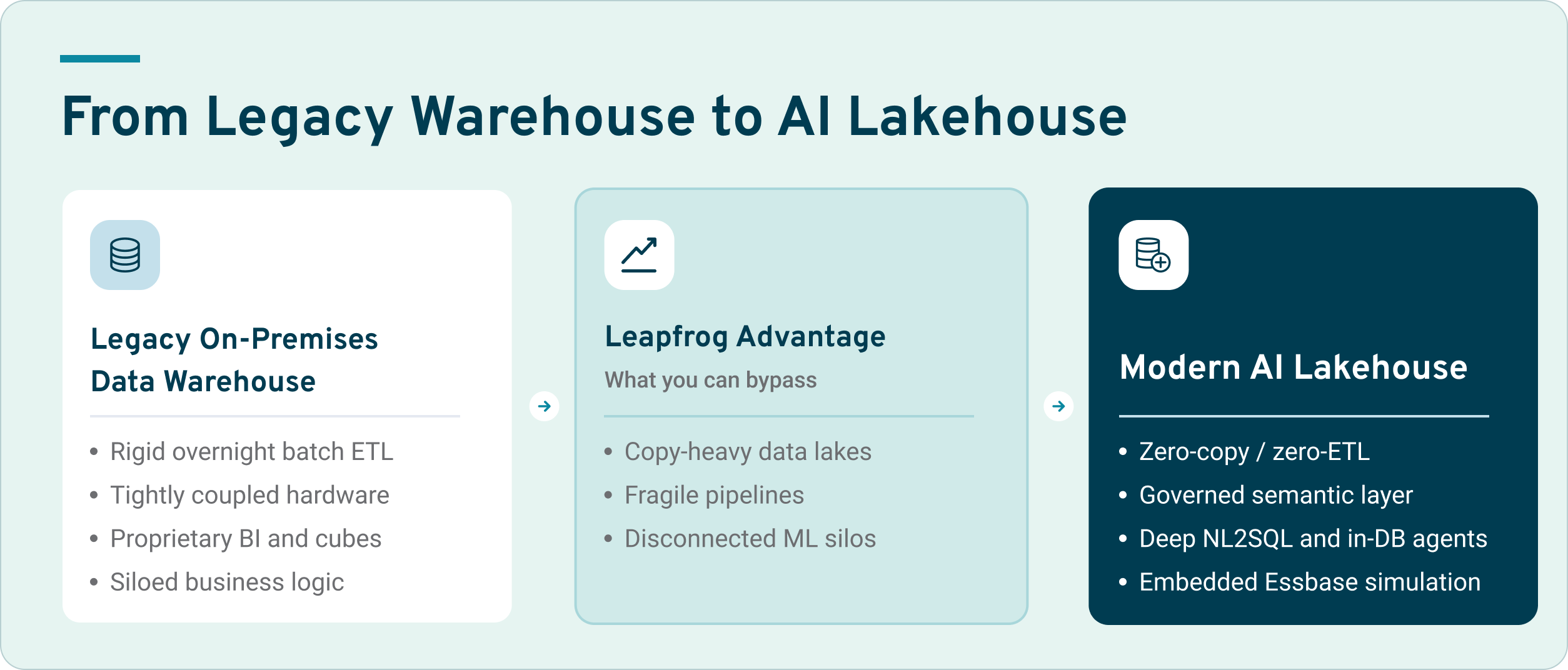
Enterprises running aging on-premises data warehouses face high infrastructure maintenance costs, rigid batch ETL windows, and proprietary reporting dependencies. Rather than following the painful, multi-year path of migrating first to an unorganized cloud data lake, these organizations have an unprecedented opportunity to leapfrog directly to an AI-native lakehouse.
1. Foundation & In-Place Federation (Zero-Copy & Hybrid Deployment)
The modernization journey begins without requiring an immediate, disruptive "rip-and-replace" migration.
-
Hybrid and Multicloud Flexibility: Organizations with data sovereignty, regulatory, or low-latency constraints can deploy the AI Lakehouse via hybrid architectures (such as Oracle Exadata Cloud@Customer or OCI Dedicated Region), or natively across AWS, Azure, GCP, and OCI.
-
Lift-and-Extend: Legacy schemas, stored procedures, and existing SQL logic carry forward directly to Autonomous AI Lakehouse without rewriting analytical applications.
-
Cataloging Existing Data in Place: The AI Data Catalog mounts on-premises databases and object storage (e.g., Oracle ZFS, Hitachi) alongside cloud stores. Teams can query distributed assets live with standard SQL, establishing immediate visibility without mass data copying.
2. Streamlining and Eliminating the ETL Window
In legacy architectures, overnight batch windows often fail to complete before the business day begins, leaving leaders with stale information.
-
Zero-ETL and Live Federation: Features like Live AI Hub and Data Hub federation query operational databases in place, pushing processing and filter predicates down to the source so only the required query results cross the wire.
-
Real-Time Data Pipelines: Where data must be consolidated or transformed into open formats, technologies like Oracle GoldenGate continuously replicate changes in real time into object storage, while native low-code engines (e.g., Data Transforms) execute set-based ELT directly inside the database or target Iceberg tables. Real-time transactions become immediately available for analytics and vector generation.
3. Preserving Modeling Discipline while Activating the Business Semantic Layer
Moving to an AI Lakehouse does not mean abandoning data modeling fundamentals. Star schemas, normalized relational integrity, and slowly changing dimensions (SCDs) still matter; what has changed is the platform underneath them.
-
While platforms provide technical versioning and time-travel snapshots, business history still requires intentional SCD design.
-
Enriching Schema to Semantics: In legacy environments, business context (such as fiscal calendars, margin calculations, and status codes) remained trapped inside proprietary BI reports or stored procedures. The AI Lakehouse extracts existing database SQL annotations, table constraints, and Analytic Views into a central Business Semantic Layer.
-
AI-Assisted Ontologies: Using an integrated AI Discovery agent, the platform inspects schemas, API docs, and enterprise documents to map business entities, relationships, and operational rules into a governed Business Knowledge Graph, which domain experts review and approve.
4. Democratizing the Consumption Layer: Deep NL2SQL & In-Database Agents
Legacy BI models depended heavily on centralized reporting teams building static dashboards in proprietary BI tools. The AI Lakehouse democratizes access through conversational intelligence:
-
Deep NL2SQL with Trust and Verification: Generic LLMs struggle with enterprise schemas due to cryptic table names (e.g., PS_JOB, GL_JE_LINES), jargon, and ambiguous user phrasing. Oracle's Deep NL2SQL maps questions to hierarchical topics in the Business Knowledge Graph, disambiguates user intent through human-in-the-loop clarification, inspects business rules (such as excluding returned products from revenue), and executes self-reflection before generating trusted, explainable SQL.
-
Agent-Driven Workflows: Business users interact with approved agents via unified interfaces like Oracle Agent Hub or third-party assistants (e.g., ChatGPT, Claude). Rather than merely generating charts, in-database Agent Engines execute declarative workflows (ReAct, parallel, routing, loops) alongside the data, enforcing role-based disclosure contracts and human approval gates before consequential business actions are taken.
5. Native Multidimensional Simulation (Embedded Essbase)
Traditional data warehouses required exporting data into standalone OLAP cubes for financial consolidation, budgeting, and what-if forecasting. The modern AI Lakehouse embeds multidimensional modeling (Oracle Essbase) natively into the engine. Finance and planning teams run allocations, dynamic hierarchy rollups, and scenario simulations with write-back directly against live lakehouse and Iceberg data—interfacing either through natural language or Excel (Oracle Smart View) without spinning up separate OLAP servers.
Comparing the Two Paths: Legacy DW Leapfroggers vs. Early Lakehouse Adopters
Understanding how the modern AI Lakehouse disrupts the enterprise landscape requires comparing organizations leapfrogging from legacy warehouses against those that built cloud lakehouses over the past 2–4 years.
| Architectural Dimension | Legacy On-Premises DW | First-Generation Cloud Lakehouse (2022–2024) | Modern Autonomous AI Lakehouse (2026) |
|---|---|---|---|
| Storage & File Format | Proprietary, coupled on-prem disk / SAN; rigid relational tables. | Object storage (S3/ADLS/GCS); static Parquet/ORC with Hive metastores or early Delta/Iceberg. | Universal Apache Iceberg (V2/V3) with ACID transactions, time travel, liquid clustering, and Puffin statistics. |
| Data Ingestion & Movement | Nightly batch ETL windows; high maintenance; brittle pipelines. | Copy-heavy batch Spark/Glue jobs moving data across Bronze, Silver, and Gold tiers. | Zero-Copy federation & Zero-ETL; in-place queries, change-data capture, and pushdown predicates. |
| Catalog & Governance | Isolated database dictionaries and siloed BI tool metadata. | Siloed catalogs (Glue vs. Unity vs. Purview); static bucket-level IAM policies. | Federated REST Catalog (Apache Polaris) acting as a "catalog of catalogs"; table-level credential vending. |
| Business Context & Semantics | Trapped in proprietary BI cubes, reports, and DBA institutional knowledge. | The "Context Gap": Technical schemas only; cryptic column codes; dbt models without agent context. | Active Business Semantic Layer & Ontologies; self-enriching knowledge graphs; AI-suggested Analytic Views. |
| Consumption & Interaction | Specialized SQL developers, report writers, and proprietary BI platforms. | BI dashboards (Tableau, Power BI, QuickSight) and isolated ML/Python notebooks. | Deep NL2SQL & In-Database AI Agents (Agent Hub, MCP tools, conversational self-service, embedded Essbase). |
| Security & Auditing | Database-native row/column security (e.g., VPD) restricted to the relational engine. | Fragmented across cloud IAM, lake formation, and external warehouse permissions. | Deep Data Security & OpenLineage; object-level policies and identity propagated to Iceberg and agents. |
Why First-Gen Cloud Lakehouses Face a Strategic Dilemma
Organizations that invested heavily in cloud data lakes and first-gen lakehouses 2–4 years ago thought they were building the ultimate modern stack. Today, many find their architectures stalling when attempting to operationalize Agentic AI:
-
The Context Gap Breaks Autonomous Agents: Pointing an LLM or autonomous agent at raw S3 buckets, Hive tables, or Glue catalogs leads to hallucinations and runaway token costs. Agents do not understand effective-dated logic, industry jargon, or cryptic ERP columns (e.g., CUST_STAT_CD = 'A'), nor do they inherit operational join paths.
-
The Burden of Copy-Heavy Pipelines: Early lakehouse architectures institutionalized copying data across multiple storage tiers. This creates synchronization lag, governance blind spots, and steep storage/compute bills.
-
Fragmented Execution Stacks: First-gen setups stitched together separate tools: one engine for ETL (Spark), one for warehousing (Redshift/Snowflake), another for vector search (OpenSearch/pgvector), and another for agent orchestration (external LangChain/LangGraph frameworks). This creates multiple credential stores, high data transfer latencies, and complex synchronization requirements.
The Disruption of Zero-Copy and the Leapfrog Advantage
This dynamic gives legacy data warehouse customers an unexpected advantage:
-
Avoiding Sunk Costs: Early cloud lakehouse adopters face a major re-architecture effort—upgrading legacy Parquet to Iceberg V2/V3, deploying Polaris-compliant REST catalogs, and retrofitting semantic layers onto raw object storage.
-
Zero-Copy Interoperability for Existing Investments: For customers who already built an AWS or Azure lakehouse, the modern AI Lakehouse does not require scrapping those investments. By mounting existing AWS Glue, Databricks Unity, or Snowflake Horizon catalogs into the AI Data Catalog via a single command, teams can immediately query their existing S3 Iceberg tables in place using converged SQL, vector indexing ("Vectors on Ice"), and Exadata Lake Cache without moving petabytes of data.
-
Clean-Slate Leapfrogging for Legacy DW: Organizations still on legacy on-premises warehouses can bypass the entire "copy-heavy data lake" phase. They move straight from traditional relational warehousing to an architecture where data stays where it is, ETL is minimized through zero-copy federation, and business semantics directly power autonomous AI agents and executive natural-language decisioning.




See The Team In Action