

.svg)


.svg)




.svg)

-2.svg)
-1.svg)


.svg)


.svg)
.svg)
.svg)

.svg)

.svg)
.svg)


.svg)

.svg)
.svg)
.svg)
.svg)
.svg)
.svg)
.svg)
.svg)
.svg)


.svg)
.svg)
.svg)
.svg)


.svg)
-1.svg)
.svg)
.svg)
.svg)

.svg)
.svg)

.svg)
.svg)

.svg)
.svg)
.svg)
.svg)
.svg)
.svg)
.svg)

.png?width=200&height=200&name=Saurabh%20Mishra%20(1).png)
.svg)


About Guest
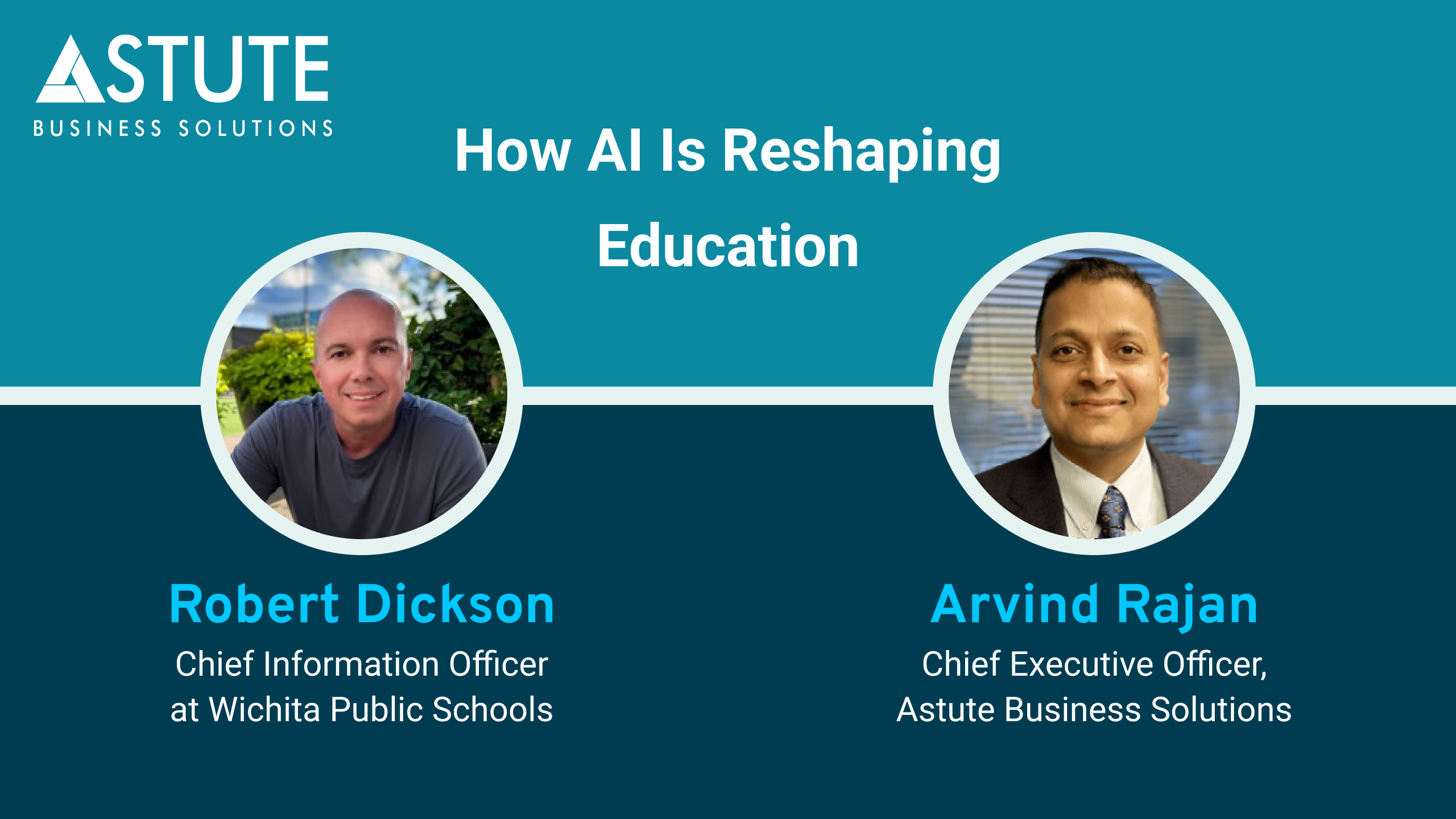
Robert Dickson is the Chief Information Officer at Wichita Public Schools, leading technology strategy for one of the largest school districts in Kansas, serving over 50,000 students. With over two decades in education technology, he has driven initiatives in digital transformation, virtual learning, and secure, scalable infrastructure.
He is the force behind innovative programs like Education Imagine Academy and district-wide digital literacy efforts, focused on making learning more accessible and future-ready. A Kansas City CIO of the Year (ORBIE Award) winner, Robert is widely recognized for shaping how technology enables modern education.
Artificial intelligence is no longer a future concept—it’s a present-day force reshaping how organizations operate, plan, and deliver value. In this episode, Rob Dickson, CIO of Wichita Public Schools, shares how one of the largest school districts in Kansas is actively experimenting with AI to drive both operational efficiency and instructional innovation.
From building AI-powered lesson planning tools to creating research-driven intelligence systems, Rob offers a behind-the-scenes look at how AI is being deployed in real-world environments. He emphasizes the importance of starting with clear problem statements—not chasing shiny tools—and highlights how trust, guardrails, and data privacy must underpin every AI initiative.
But this conversation goes beyond education. It explores a broader shift: the move from AI as a tool to AI as a system that can autonomously execute tasks. As the pace of change accelerates, leaders must rethink planning cycles, workforce readiness, and even how intelligence is embedded into everyday workflows.
Whether you're in education, enterprise IT, or leadership, this episode offers practical insights—and a wake-up call—to stay relevant in an AI-driven world.
Top 10 Highlights / Takeaways
- AI is not a fad—it’s a foundational shift comparable to the internet.
- Traditional long-term planning is breaking down; 90-day planning cycles may become the norm.
- Trust is the biggest barrier to AI adoption—leaders must build it through controlled use cases.
- Starting with problem statements (not tools) is critical for meaningful AI implementation.
- AI is already improving productivity—developers are becoming 2–3x more effective.
- Education will see slower AI adoption on the instructional side due to human and cultural factors.
- AI enables personalization in education, especially in lesson planning and student engagement.
- Data literacy → AI literacy → digital literacy is the new learning hierarchy.
- Context windows and data handling are critical—but poorly understood—AI limitations.
- The future is “intelligence applied to every task”—and organizations must actively keep up to survive.
From Tools to Intelligence: How AI Is Reshaping Education and Enterprise Leadership
Artificial intelligence is no longer just another technology trend—it’s becoming the foundation on which modern organizations will operate. In a recent episode of the AI Driven Enterprise Podcast, Rob Dickson, CIO of Wichita Public Schools, offered a grounded yet forward-looking perspective on what this shift actually looks like in practice.
His message was clear: we are not just adopting AI—we are entering a world where intelligence can be applied to almost every task.
The Shift from Tools to Systems
One of the most compelling ideas from the conversation is the transition from AI as a “tool” to AI as an autonomous system. Today, most organizations still interact with AI through chat-based interfaces. But Rob highlighted how emerging systems can take a request, break it into sub-tasks, execute them, and deliver outcomes with minimal human intervention.
This is a significant leap.
Instead of simply asking AI questions, leaders are beginning to delegate entire workflows. This shift challenges traditional notions of productivity, ownership, and even skill development. It also raises important questions about trust—arguably the most critical factor in AI adoption.
Why Trust Comes Before Scale
Rob emphasized that trust must be built before AI can be deployed in production environments. His approach is simple but effective: start with low-risk use cases.
Rather than feeding sensitive data into AI systems, he begins with research and productivity tasks—allowing the technology to prove its value without introducing risk. This phased approach helps organizations understand how AI behaves, how data flows through systems, and where potential vulnerabilities lie.
For leaders, this is a crucial takeaway. AI adoption is not just a technical challenge—it’s a trust-building exercise.
Education as a Testing Ground
While much of the AI conversation is centered around enterprise use cases, education offers a unique lens into how these technologies will shape the future.
In Wichita Public Schools, AI is already being used to enhance operational efficiency. Developers are becoming significantly more productive, reducing the need for additional hires. But the more interesting applications are happening on the instructional side.
Rob shared an example of an AI-powered lesson planning tool designed for teachers who may not have expertise in certain subjects. By combining state standards with domain knowledge, the tool helps teachers create personalized, high-quality lesson plans tailored to different student needs.
This is where AI’s true potential begins to emerge—not as a replacement for human expertise, but as an amplifier.
The Challenge of Human Adoption
Despite these advances, adoption in education—and many other sectors—remains uneven. The reason is not technological, but human.
Different generations have vastly different relationships with technology. While younger students will grow up in a world where AI is ubiquitous, many educators are still adapting to the digital transformation brought on by the internet.
This creates a gap that cannot be solved by technology alone. Training, change management, and cultural alignment become just as important as the tools themselves.
The Literacy Gap: Digital, Data, AI
Another critical insight from the conversation is the need for a structured approach to AI literacy.
Rob outlined a progression: digital literacy → data literacy → AI literacy.
Many organizations skip directly to AI without ensuring that employees understand how data works or how to validate outputs. This creates a “wild west” scenario where decisions are made based on outputs that may not be accurate or complete.
For leaders, investing in literacy is not optional—it’s foundational.
The Hidden Complexity of AI
One of the more nuanced points discussed was the concept of context windows—the amount of data an AI model can process at once.
While this may seem like a technical detail, it has real-world implications. If an AI system cannot process all the information provided, it may produce incomplete or misleading results—without signaling that anything is missing.
This highlights a broader truth: AI systems are powerful, but they are not infallible. Understanding their limitations is just as important as leveraging their capabilities.
Data Privacy and Responsibility
As AI becomes more integrated into workflows, data privacy concerns are becoming more complex.
Rob emphasized the importance of understanding the full lifecycle of data—where it originates, how it is processed, and whether it is used for model training. This is particularly critical in sectors like education and healthcare, where sensitive information is involved.
Organizations must also adapt their governance models. Traditional data classifications may not account for data generated by AI systems, creating new risks that must be addressed.
A New Era of Planning
Perhaps the most striking takeaway from the conversation is the need to rethink planning itself.
The pace of AI innovation is so rapid that traditional multi-year strategies may no longer be viable. Instead, leaders may need to adopt shorter planning cycles—continuously adapting to new capabilities and disruptions.
This is not just a shift in process—it’s a shift in mindset.
The Road Ahead
Looking forward, Rob predicts a world where intelligence can be applied to any task. As constraints around memory and compute continue to evolve, AI systems will become even more capable and integrated.
For organizations, the message is clear: this is not a moment to observe from the sidelines.
Leaders must engage, experiment, and adapt. Because in an AI-driven world, the ability to keep up may be the difference between relevance and obsolescence.