

.svg)


.svg)




.svg)

-2.svg)
-1.svg)


.svg)


.svg)
.svg)
.svg)

.svg)

.svg)
.svg)


.svg)

.svg)
.svg)
.svg)
.svg)
.svg)
.svg)
.svg)
.svg)
.svg)


.svg)
.svg)
.svg)
.svg)


.svg)
-1.svg)
.svg)
.svg)
.svg)

.svg)
.svg)

.svg)
.svg)

.svg)
.svg)
.svg)
.svg)
.svg)
.svg)
.svg)


.svg)


About Guest
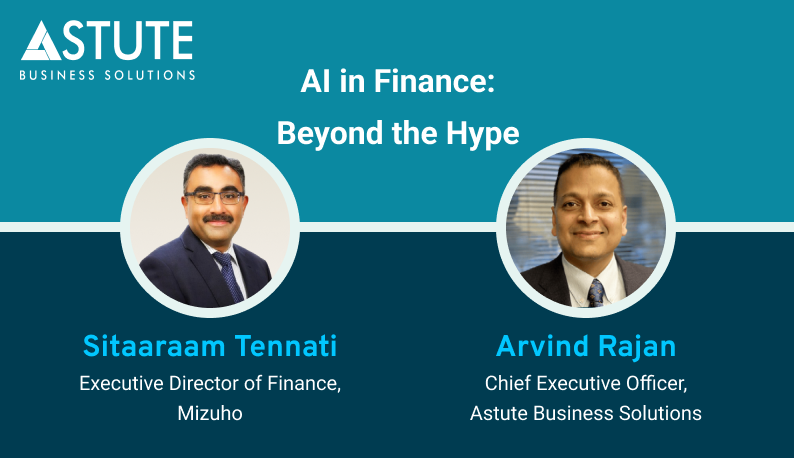
Sitaaraam Tennati is a senior professional (ACA, Master's in Finance, FRM) with 25+ years of experience in Finance, Risk, and Big 4 Audit/Consulting. He has extensive experience leading & managing the Financial Control and External Reporting functions as well as driving Strategic Finance Change. His key strengths lie in bringing together a sound understanding of finance processes, a strong controls-driven work ethic, and effective stakeholder management skills to deliver optimal outcomes. He is experienced in engaging at C-Suite levels and dealing with Audit Committees and the Board of Directors.
Artificial intelligence is rapidly becoming central to enterprise strategy. However, in finance, adoption comes with unique challenges. Unlike other functions, finance operates in a zero-error environment where accuracy, auditability, and compliance are non-negotiable.
In this episode of the AI Driven Enterprise Podcast, Sitaaraam Tennati shares a grounded perspective on what it truly takes to implement AI in finance. Drawing on over 25 years of experience in global banking, he highlights the foundational elements organizations must address before scaling AI initiatives.
The conversation focuses on the realities often overlooked in AI adoption, including data quality, governance frameworks, and the need for explainability. It also explores how AI is reshaping the role of finance professionals and what skills will be required in the future.
This episode is essential for finance leaders, transformation heads, and enterprise decision-makers looking to adopt AI responsibly and effectively.
Top 10 Highlights / Takeaways
- AI in finance demands near-perfect accuracy; even minor errors carry significant risk
- Data quality and data lineage are foundational to successful AI initiatives
- Poor data leads to unreliable AI outputs and flawed decisions
- Finance leaders must approach AI adoption with cautious optimism
- Governance and guardrails must be established before deployment
- Explainability is critical due to regulatory and audit requirements
- AI will augment, not replace, finance professionals
- Roles will shift toward insight interpretation and strategic decision-making
- AI can enhance reporting, data synthesis, and insight generation
- Transformation of systems and processes must precede AI adoption
AI in Finance: Why Data, Governance, and Judgment Matter More Than Hype
Artificial intelligence is dominating enterprise conversations. While many industries are rapidly adopting AI, finance operates under stricter conditions. Every output must be accurate, explainable, and auditable.
This raises a critical question: can AI truly be trusted in finance?
Opportunity Meets Responsibility
AI presents clear opportunities in finance. It can automate repetitive tasks, accelerate reporting, and improve data connectivity across systems.
However, these benefits come with risks. Decisions in finance depend on precision and accountability. This makes skepticism not a barrier, but a necessary discipline.
The Real Starting Point Is Data
A key insight from the discussion is that AI is not the starting point. Data is.
Organizations often assume AI tools will fix inefficiencies. In reality, AI amplifies existing data conditions. If data is incomplete or inconsistent, AI outputs will be equally flawed.
Critical focus areas include:
- Data quality: ensuring accuracy and reliability
- Data lineage: understanding how data flows across systems
Without these, AI becomes a risk multiplier.
The Explainability Challenge
AI models often operate as black boxes, producing outputs without clear reasoning.
In finance, this lack of transparency is unacceptable. Every number must be traceable and defensible.
To address this, organizations must:
- Build systems with explainable outputs
- Ensure audit trails for all AI-driven decisions
- Enable validation at every stage
Some enterprises are even deploying AI systems to audit other AI models.
The Evolving Role of Finance Professionals
AI is not eliminating finance roles. It is redefining them.
Traditionally, finance teams spend significant time on data preparation and reporting. AI reduces this burden, allowing professionals to focus on higher-value activities.
Future roles will emphasize:
- Interpretation of insights
- Strategic decision-making
- Business judgment
The New Skill Stack
As AI becomes embedded in finance workflows, required skills are evolving.
Professionals must develop:
- Data literacy to understand sources and flows
- AI literacy to interpret and validate outputs
Without these capabilities, organizations risk over-reliance on AI without proper oversight.
Where AI Delivers Immediate Value
While full transformation takes time, AI can deliver value in specific areas:
- Financial reporting automation
- Multi-source data integration
- Conversational analytics
- Personalized reporting
These use cases reduce manual effort while improving speed and accuracy.
Transformation Before AI
A common mistake is adopting AI before fixing foundational issues.
Successful AI implementation requires:
- Modern ERP systems
- Standardized processes
- Structured data environments
AI works best as an enhancement layer, not a corrective tool.
Conclusion: Trust Is the Real Metric
AI adoption in finance is not about speed. It is about trust.
Organizations must ensure:
- Trust in data
- Trust in processes
- Trust in outputs
Those who succeed will not be the fastest adopters, but the most thoughtful ones.
AI in finance is not just automated. It is accountable.